Takashima Talks in Japanese Cultural Studies: "Japanese Sex Workers, Rights, and the Gendered Economy"

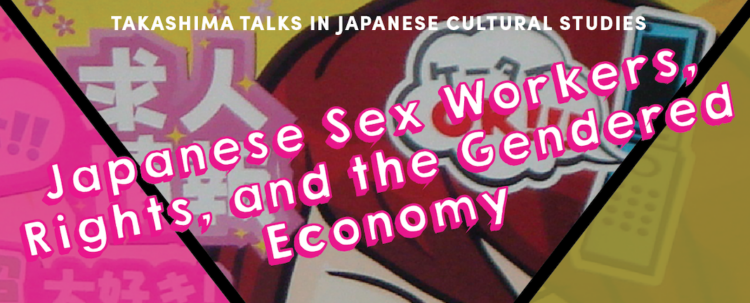
Takashima Talks: Japanese Sex Workers, Rights, and the Gendered Economy

Contemporary Japan is home to one of the world’s largest and most diversified markets for sex.  Widely understood to be socially necessary, the sex industry operates and recruits openly, staffed by a diverse group of women who are attracted by its high pay and the promise of autonomy — but whose work remains stigmatized and dangerous.  This talk reframes the labor of adult Japanese women working in Tokyo’s legal sex industry as female care work.  Sex as care, I argue, reflects the simultaneous importance and marginality of female sex workers in Japan as well as the political-economic roles and possibilities that they imagine for themselves.

Gabriele Koch is a sociocultural anthropologist who studies care and its contestations in contemporary Japan.  She is Assistant Professor of Anthropology at Yale-NUS College and author of Healing Labor:  Sex Work in the Gendered Economy (Stanford University Press, 2020).  Her work has also appeared in American Ethnologist and Critical Asian Studies, and is forthcoming in the Journal of Legal Anthropology.  Her current research focuses on the recent re-imagination of Japanese forests as agents of human well-being.

Wednesday, December 8, 2021

5:30 PM – 7:00 PM

McCune Conference Room & Live Streamed

"Rosewood: Endangered species conservation and the rise of global China"

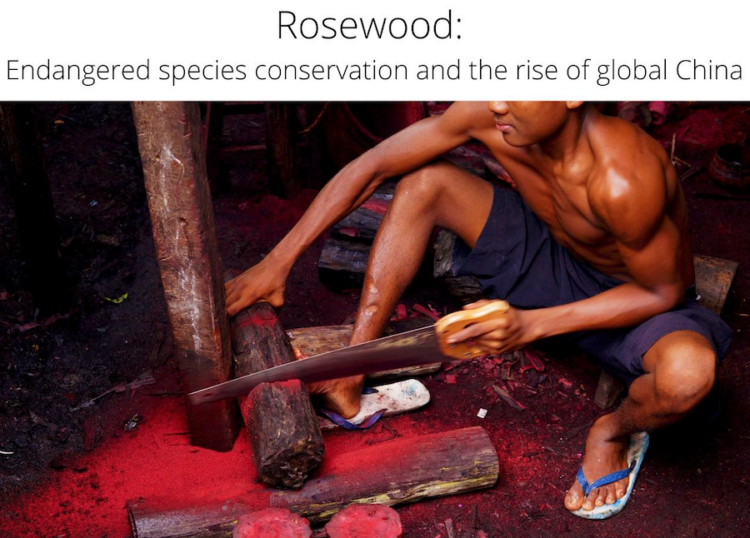
Rosewood: Endangered Species Conservation and the Rise of Global China

Rosewood is the world’s most trafficked endangered species by value, accounting for larger outlays than ivory, rhino horn, and big cats put together. Nearly all rosewood logs are sent to China, fueling a $26 billion market for classically styled furniture. Vast expeditions across Asia and Africa search for the majestic timber, and legions of Chinese ships sail for Madagascar, where rosewood is purchased straight from the forest. The international response has been to interdict the trade, but this misunderstands both the intent and effect of China’s appetite for rosewood, causing social and ecological damage in the process. Drawing on fieldwork in China and Madagascar, Annah Zhu upends the pieties of Western-led conservation, offering a glimpse of what environmentalism and biodiversity protection might look like in a world no longer ruled by the West.

Annah Zhu is an Assistant Professor of environmental globalization at Wageningen University in the Netherlands. She received her PhD in society and environment from the University of California, Berkeley and her Masters in environmental management from Duke University. She is a veteran of the United Nations’ Environment Program in Geneva, and a former Peace Corps volunteer in Madagascar. Her work has been published in Science, Geoforum, Political Geography, Environment International, and American Ethnologist.

Thursday, December 2nd, 2021
3:30 PM — 5:00 PM
University of California, Santa Barbara
Humanities & Social Change Center
Robertson Gymnasium 1000A
Cosponsors: Capps Center for the Study of Ethics, Religion, and Public Life; Department of East Asian Languages and Cultural Studies; Environmental Studies Program
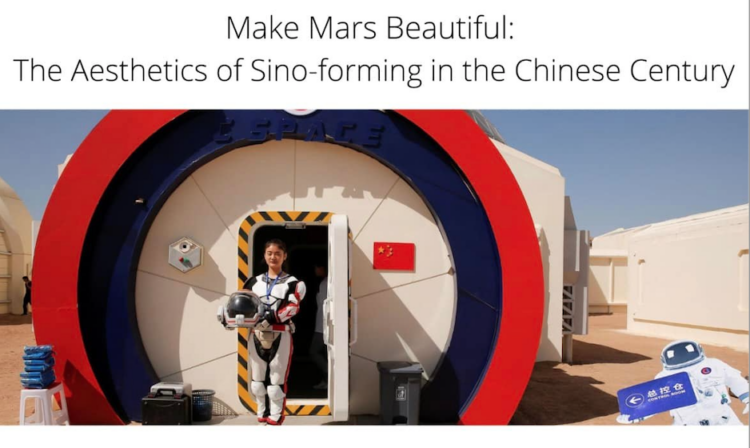
"Make Mars Beautiful: The Aesthetics of Sino-forming in the Chinese Century"

Make Mars Beautiful: The Aesthetics of Sino-forming in the Chinese Century

China plans to send its first manned mission to Mars by 2033, and eventually establish a permanent colony on the planet. Many outside China see this ambitious turn towards space colonization as an attempt to establish global leadership in science and technology. But what is the cultural significance of Mars and Martian colonization for the Chinese? To form a better appreciation for Chinese conceptualizations of the relationship between nature and humanity that will shape the country’s interplanetary future, George Zhu urges us to begin with one of China’s most well known artistic treasures, the Meat Shaped Stone. Making connections across centuries of art, environmental management, and imperial ambition, Zhu outlines a possible future for Mars–and the Earth–in what portends to be the Chinese century.

George Zhu received his master’s in English literature from the University of California Irvine. He is the co-founder of Double Bind Media, a production company specializing in experimental documentary film and other visual media based in Los Angeles and the Netherlands. Currently, he resides in the Netherlands where he develops and produces a range of multidisciplinary new media work. He is also a writer interested in contemporary Chinese culture, environmentalism, endangered species, climate change, and science studies.

Wednesday, December 1st, 2021
1:00 PM — 2:30 PM
University of California, Santa Barbara
Humanities & Social Change Center
Robertson Gymnasium 1000A
Cosponsors: Capps Center for the Study of Ethics, Religion, and Public Life; Department of East Asian Languages and Cultural Studies; Environmental Studies Program
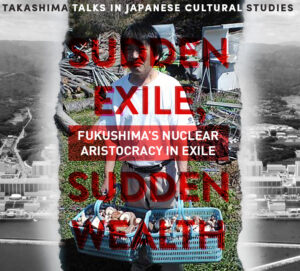
"Sudden Exile, Sudden Wealth: Fukushima's Nuclear Aristocracy in Exile" Takashima Talks in Japanese Cultural Studies

Guest Talk with Tom Gill: Sudden Exile, Sudden Wealth: Fukushima’s Nuclear Aristocracy in Exile

Radiation from the Fukushima nuclear disaster of 2011 broke up local communities by forcing their inhabitants into exile in locations scattered though the prefecture.  In subsequent years, government compensation policy created further divisions within these ruptured communities, by providing wildly varying amounts of compensation according to the classification of danger in each district.  The most handsomely compensated were those in the “hard-to-return-zones” where many households received the equivalent of US $1 million dollars or more.  They have been cursed with the loss of their homeland and the lingering fear of radiation health risks, blessed with sudden wealth, then cursed again with “envy discrimination” by those less well compensated.

TOM GILL is a British social anthropologist and professor in the Faculty of International Studies at Meiji Gakuin University, Yokohama, Japan.  He is author of two books about Japanese casual laborers, Men of Uncertainty (2011) and Yokohama Street Life (2015).  Since April 2011 he has been following the fortunes of the inhabitants of Nagadoro, a hamlet which to this days remains closed for habitation due to the Fukushima nuclear disaster.

WEDNESDAY, November 17, 5:30 – 7 PM at SS&MS 2135.  Live event.

Flyer for Zoom Talk "(Auto)Ethnography and Identity in Contemporary Taiwan: The Oceanic Epistemology of Syaman Rapongan & Indigenous Alterity Heather Tsui" on 11/1/21 from 12-1:30PM PDT

Upcoming Talk: Kyle Shernuk, “(Auto)Ethnography and Identity in Contemporary Taiwan”

As part of the “Sound, Screen, and Stages from Taiwan” series at the Center for Taiwan Studies, we are pleased to welcome Prof. Kyle Shernuk (Queen Mary University of London) to speak on “(Auto)Ethnography and Identity in Contemporary Taiwan: The Oceanic Epistemology of Syaman Rapongan & Indigenous Alterity of Heather Tsui.”

The talk will take place on Monday, November 1, 2021, at 12:00–1:30pm PDT. Join us at: http://ucsb.zoom.us/j/82164088119. For more information, please consult the poster or email eastasian-taiwanstudies@ucsb.edu.