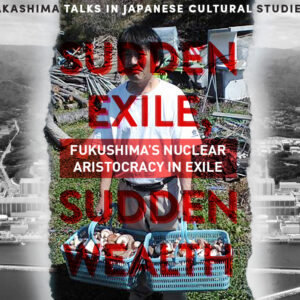
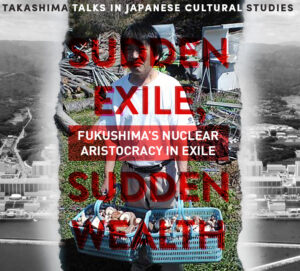
"Sudden Exile, Sudden Wealth: Fukushima's Nuclear Aristocracy in Exile" Takashima Talks in Japanese Cultural Studies

Guest Talk with Tom Gill: Sudden Exile, Sudden Wealth: Fukushima’s Nuclear Aristocracy in Exile

Radiation from the Fukushima nuclear disaster of 2011 broke up local communities by forcing their inhabitants into exile in locations scattered though the prefecture.  In subsequent years, government compensation policy created further divisions within these ruptured communities, by providing wildly varying amounts of compensation according to the classification of danger in each district.  The most handsomely compensated were those in the “hard-to-return-zones” where many households received the equivalent of US $1 million dollars or more.  They have been cursed with the loss of their homeland and the lingering fear of radiation health risks, blessed with sudden wealth, then cursed again with “envy discrimination” by those less well compensated.

TOM GILL is a British social anthropologist and professor in the Faculty of International Studies at Meiji Gakuin University, Yokohama, Japan.  He is author of two books about Japanese casual laborers, Men of Uncertainty (2011) and Yokohama Street Life (2015).  Since April 2011 he has been following the fortunes of the inhabitants of Nagadoro, a hamlet which to this days remains closed for habitation due to the Fukushima nuclear disaster.

WEDNESDAY, November 17, 5:30 – 7 PM at SS&MS 2135.  Live event.
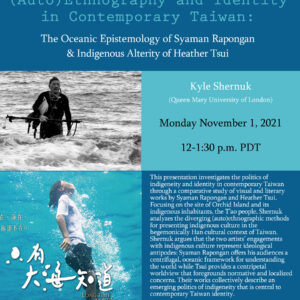
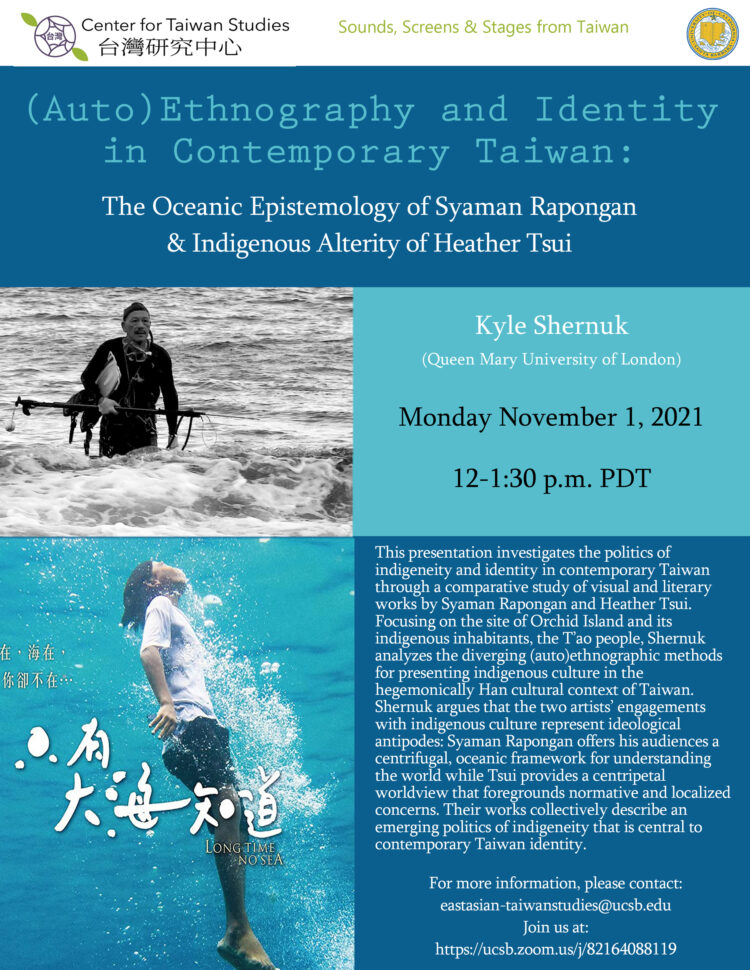
Flyer for Zoom Talk "(Auto)Ethnography and Identity in Contemporary Taiwan: The Oceanic Epistemology of Syaman Rapongan & Indigenous Alterity Heather Tsui" on 11/1/21 from 12-1:30PM PDT

Upcoming Talk: Kyle Shernuk, “(Auto)Ethnography and Identity in Contemporary Taiwan”

As part of the “Sound, Screen, and Stages from Taiwan” series at the Center for Taiwan Studies, we are pleased to welcome Prof. Kyle Shernuk (Queen Mary University of London) to speak on “(Auto)Ethnography and Identity in Contemporary Taiwan: The Oceanic Epistemology of Syaman Rapongan & Indigenous Alterity of Heather Tsui.”

The talk will take place on Monday, November 1, 2021, at 12:00–1:30pm PDT. Join us at: http://ucsb.zoom.us/j/82164088119. For more information, please consult the poster or email eastasian-taiwanstudies@ucsb.edu.

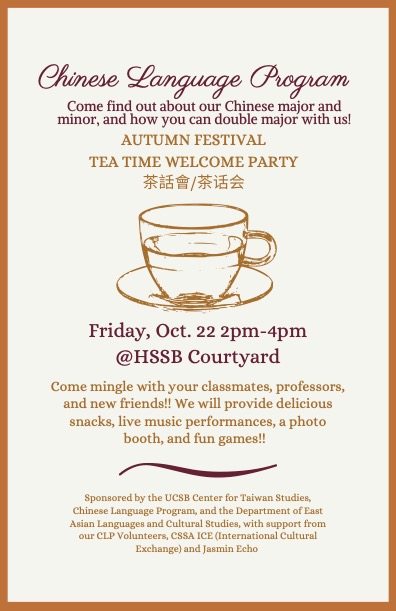
Flyer for "Chinese Language Program, Autumn Festival Tea Time Welcome Party" on 10/22/21 from 2-4PM @ HSSB Courtyard

Tea Time Welcome for Chinese Language Program

Come mingle with your classmates, professors, and new friends!! We will provide delicious snacks, live music performances, a photo booth, and fun games!!

Join us for the Chinese Language Program Autumn Festival Tea Time / Welcome Party!

Friday, Oct. 22 2pm-4pm @HSSB Courtyard

Sponsored by the UCSB Center for Taiwan Studies, Chinese Language Program, and the Department of East Asian Languages and Cultural Studies, with support from our CLP Volunteers, CSSA ICE (International Cultural Exchange) and Jasmin Echo

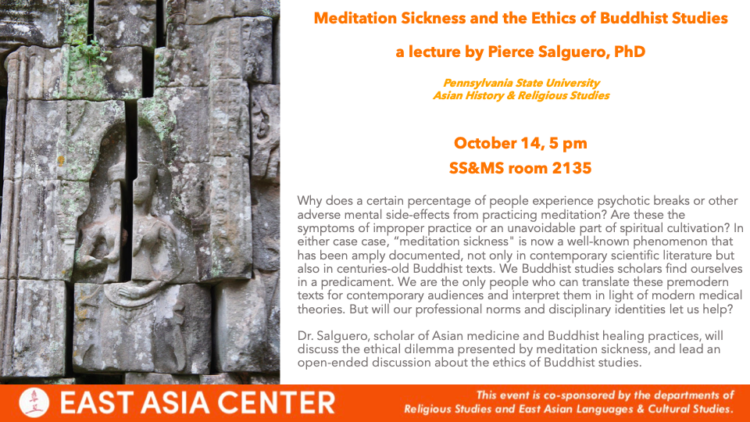
Flyer for "Meditation Sickness and the Ethics of Buddhist Studies" by Pierce Salguero on 10/14/21 at 5PM in SS&MS room 2135

Upcoming Talk by Pierce Salguero: Meditation Sickness and the Ethics of Buddhist Studies

Please join us for the first in-person event of the academic year hosted by the East Asia Center and organized by Dominic Steavu in collaboration with Religious Studies and our department.

Meditation Sickness and the Ethics of Buddhist Studies
a lecture by Pierce Salguero, PhD

October 14, 5pm
Social Science & Media Studies, room 2135

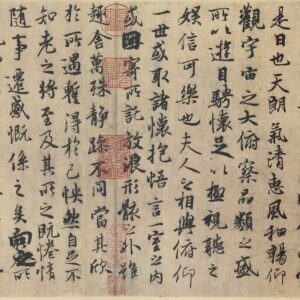
Chinese calligraphy, black ink on beige paper scroll. The text is of "Preface to Lanting Pavilion Collection" by Wang Xizhi.

Classical Chinese Placement Exam (Fall 2021)

The Classical Chinese placement exam is intended for students who have already studied some Classical Chinese (文言) and would like to skip Chinese 101A and enroll directly in Chinese 101B instead. It is offered once per year, administered by Professor Thomas Mazanec. Please email Prof. Mazanec (mazanec@ucsb.edu) if you are interested in taking this exam.

The test will take place on Tuesday, September 28, 3:30–4:30pm (location to be determined). Prof. Mazanec will provide a short passage in Classical Chinese from a Master’s text (like Mencius 孟子, Zhuangzi 莊子, or Hanfeizi 韓非子) and ask students to translate it into English, focusing on the literal meaning of the words and their grammatical relationship to one another. Students may consult a paper dictionary. Prof. Mazanec will provide several copies of Paul Kroll’s A Student’s Dictionary of Classical and Medieval Chinese for reference.

If this time is impossible for you due to scheduling conflicts, please email Prof. Mazanec by Monday, September 27, to make alternative arrangements.