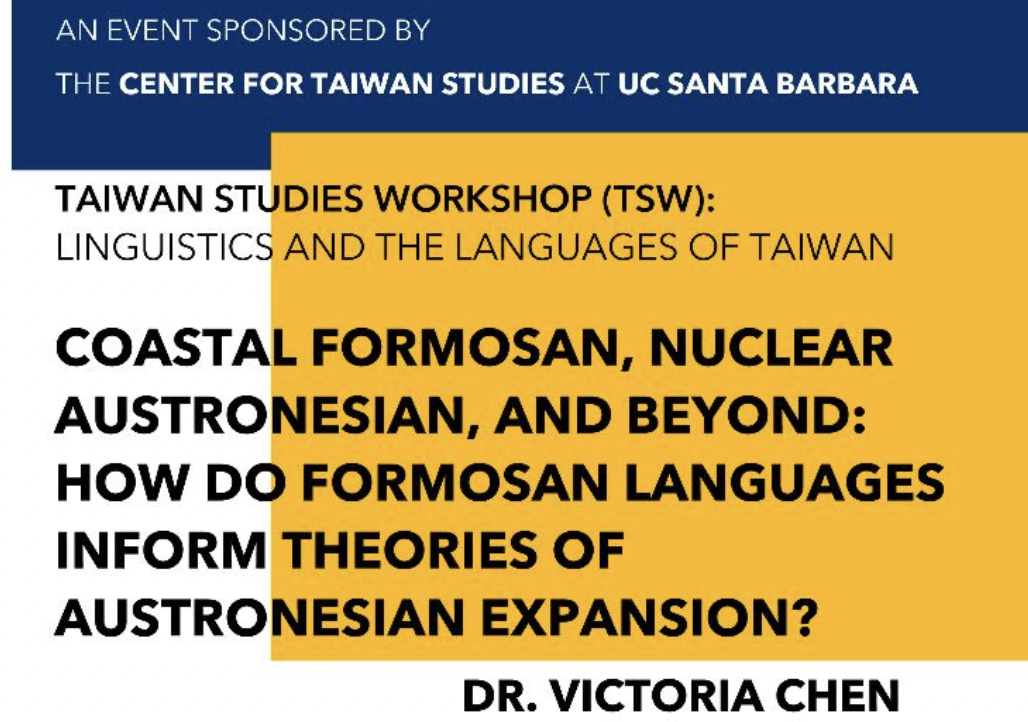
Taiwan Studies Workshop: Linguistics and the Languages of Taiwan - Coatal Formosan, Nuclear Austronesian, and Beyond: How do Formosan Languages Inform Theories of Austronesian Expansion? by Dr. Victoria Chen

Center for Taiwan Studies “Coastal Formosan, Nuclear Austronesian, and Beyond”

Please join us for “Coastal Formosan, Nuclear Austronesian, and Beyond: How do Formosan Languages Inform Theories of Austronesian Expansion?” with Victoria Chen (Victoria University of Wellington).

4:30-6:00 p.m. PST on Thursday March 3, 2022
Please register at: https://forms.gle/88TFEMBSQ1xqmVsZ6
The Zoom link will be emailed to you prior to the talk.

Poster for "Paper City", a documentary about the firebombing of Tokyo

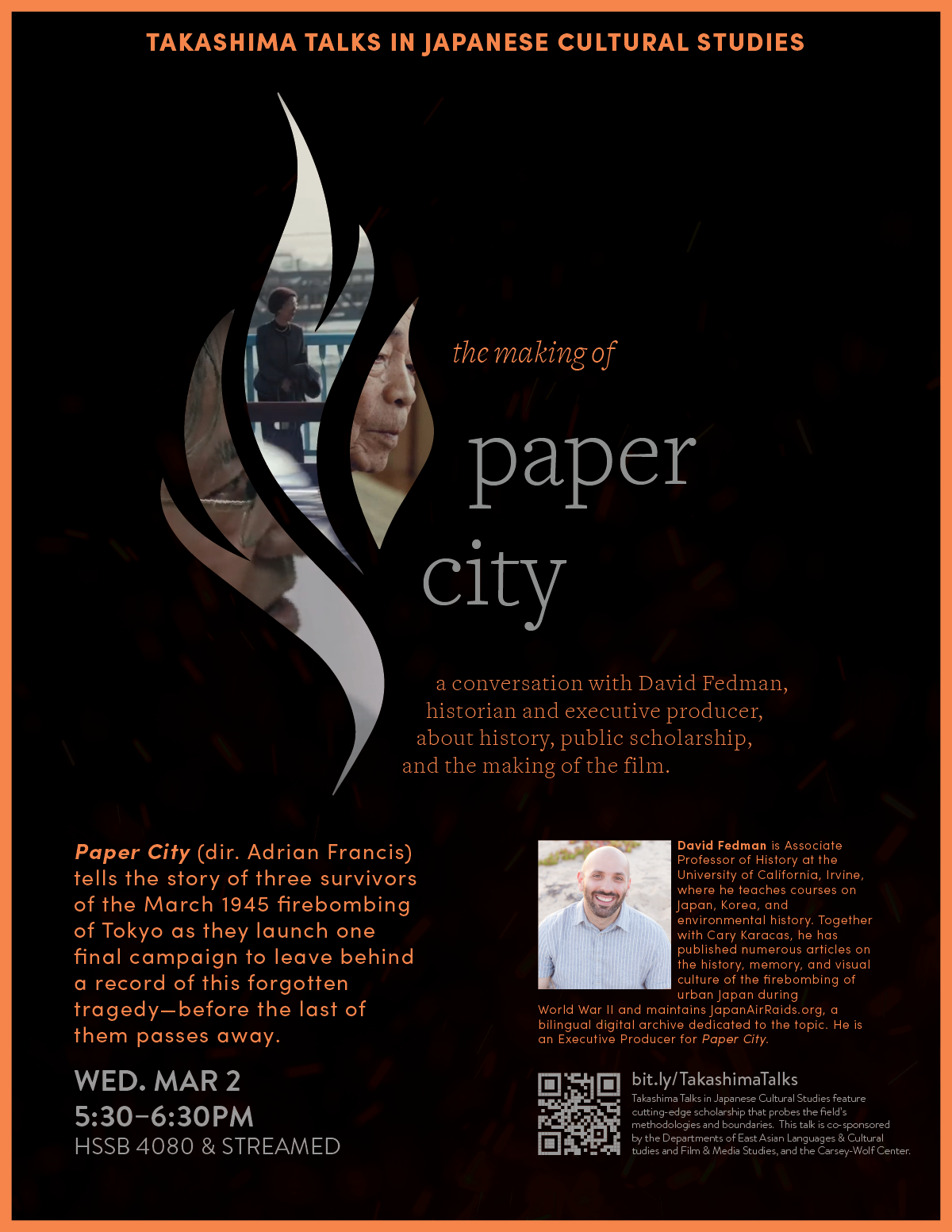
Guest Lecture on “Paper City” — A New Documentary on the Tokyo Fire Bombings

Please join us on Wednesday, March 2, 5:30 – 6:30 PM as we welcome Dr. David Fedman (UC Irvine) to discuss his new documentary, Paper City.  The documentary will make its US premiere at the Santa Barbara International Film Festival on March 3 and March 6. The documentary examines the history and memory of the Tokyo fire bombings. For those who don’t know Dr. Fedman’s work, he is the co-director of the Japan Air Raids project and one of the most prominent public historians, in the US and Japan, of the Tokyo fire bombings. He is also the author of the recent, and wonderful, monograph, Seeds of Control: Japan’s Empire of Forestry in Colonial Korea (University of Washington, 2020). If you would like to see a small sample of his work on the fire bombings, please check out his module, “Place Annihilation” in Bodies and Structures 2.0: Deep-Mapping Modern East Asian History.

You can watch a brief trailer for the film here.

We will meet in person at UC Santa Barbara on March 2, 5:30 – 6:30pm, in HSSB 4080. Please RSVP to Professor Sabine Frühstück directly at fruhstuck@eastasian.ucsb.edu.


Takashima Talks in Japanese Cultural Studies: "Japanese Sex Workers, Rights, and the Gendered Economy"

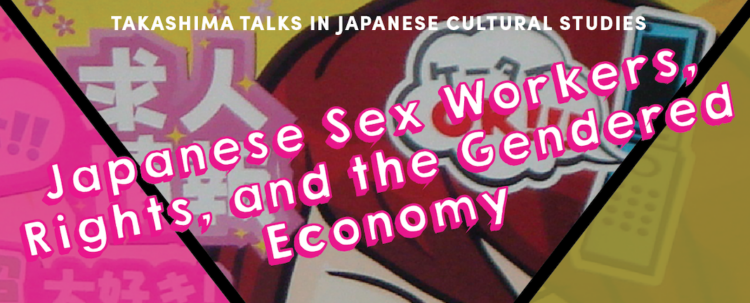
Takashima Talks: Japanese Sex Workers, Rights, and the Gendered Economy

Contemporary Japan is home to one of the world’s largest and most diversified markets for sex.  Widely understood to be socially necessary, the sex industry operates and recruits openly, staffed by a diverse group of women who are attracted by its high pay and the promise of autonomy — but whose work remains stigmatized and dangerous.  This talk reframes the labor of adult Japanese women working in Tokyo’s legal sex industry as female care work.  Sex as care, I argue, reflects the simultaneous importance and marginality of female sex workers in Japan as well as the political-economic roles and possibilities that they imagine for themselves.

Gabriele Koch is a sociocultural anthropologist who studies care and its contestations in contemporary Japan.  She is Assistant Professor of Anthropology at Yale-NUS College and author of Healing Labor:  Sex Work in the Gendered Economy (Stanford University Press, 2020).  Her work has also appeared in American Ethnologist and Critical Asian Studies, and is forthcoming in the Journal of Legal Anthropology.  Her current research focuses on the recent re-imagination of Japanese forests as agents of human well-being.

Wednesday, December 8, 2021

5:30 PM – 7:00 PM

McCune Conference Room & Live Streamed

"Rosewood: Endangered species conservation and the rise of global China"

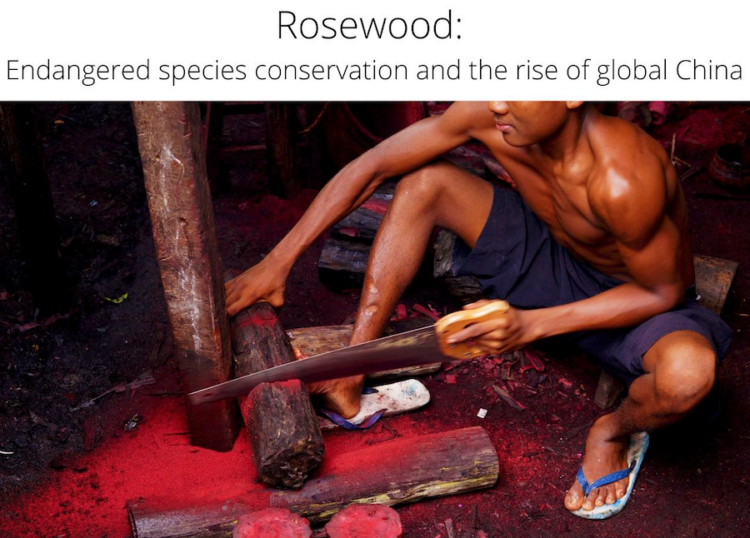
Rosewood: Endangered Species Conservation and the Rise of Global China

Rosewood is the world’s most trafficked endangered species by value, accounting for larger outlays than ivory, rhino horn, and big cats put together. Nearly all rosewood logs are sent to China, fueling a $26 billion market for classically styled furniture. Vast expeditions across Asia and Africa search for the majestic timber, and legions of Chinese ships sail for Madagascar, where rosewood is purchased straight from the forest. The international response has been to interdict the trade, but this misunderstands both the intent and effect of China’s appetite for rosewood, causing social and ecological damage in the process. Drawing on fieldwork in China and Madagascar, Annah Zhu upends the pieties of Western-led conservation, offering a glimpse of what environmentalism and biodiversity protection might look like in a world no longer ruled by the West.

Annah Zhu is an Assistant Professor of environmental globalization at Wageningen University in the Netherlands. She received her PhD in society and environment from the University of California, Berkeley and her Masters in environmental management from Duke University. She is a veteran of the United Nations’ Environment Program in Geneva, and a former Peace Corps volunteer in Madagascar. Her work has been published in Science, Geoforum, Political Geography, Environment International, and American Ethnologist.

Thursday, December 2nd, 2021
3:30 PM — 5:00 PM
University of California, Santa Barbara
Humanities & Social Change Center
Robertson Gymnasium 1000A
Cosponsors: Capps Center for the Study of Ethics, Religion, and Public Life; Department of East Asian Languages and Cultural Studies; Environmental Studies Program
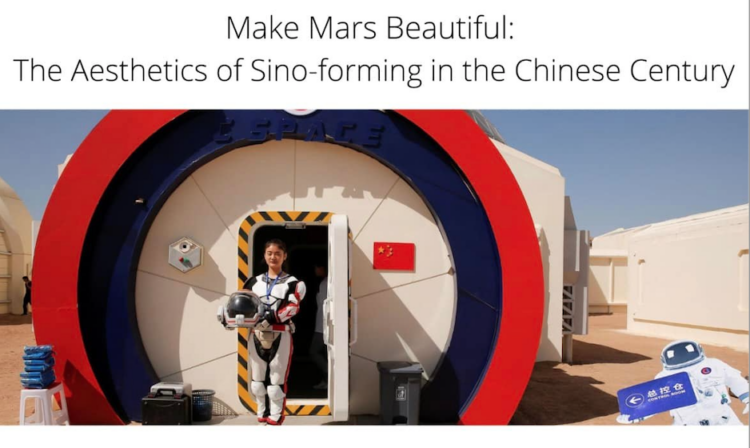
"Make Mars Beautiful: The Aesthetics of Sino-forming in the Chinese Century"

Make Mars Beautiful: The Aesthetics of Sino-forming in the Chinese Century

China plans to send its first manned mission to Mars by 2033, and eventually establish a permanent colony on the planet. Many outside China see this ambitious turn towards space colonization as an attempt to establish global leadership in science and technology. But what is the cultural significance of Mars and Martian colonization for the Chinese? To form a better appreciation for Chinese conceptualizations of the relationship between nature and humanity that will shape the country’s interplanetary future, George Zhu urges us to begin with one of China’s most well known artistic treasures, the Meat Shaped Stone. Making connections across centuries of art, environmental management, and imperial ambition, Zhu outlines a possible future for Mars–and the Earth–in what portends to be the Chinese century.

George Zhu received his master’s in English literature from the University of California Irvine. He is the co-founder of Double Bind Media, a production company specializing in experimental documentary film and other visual media based in Los Angeles and the Netherlands. Currently, he resides in the Netherlands where he develops and produces a range of multidisciplinary new media work. He is also a writer interested in contemporary Chinese culture, environmentalism, endangered species, climate change, and science studies.

Wednesday, December 1st, 2021
1:00 PM — 2:30 PM
University of California, Santa Barbara
Humanities & Social Change Center
Robertson Gymnasium 1000A
Cosponsors: Capps Center for the Study of Ethics, Religion, and Public Life; Department of East Asian Languages and Cultural Studies; Environmental Studies Program