Recent News

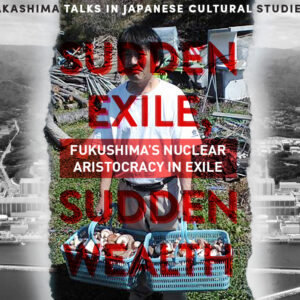
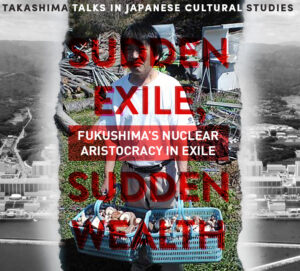
"Sudden Exile, Sudden Wealth: Fukushima's Nuclear Aristocracy in Exile" Takashima Talks in Japanese Cultural Studies

Guest Talk with Tom Gill: Sudden Exile, Sudden Wealth: Fukushima’s Nuclear Aristocracy in Exile

Radiation from the Fukushima nuclear disaster of 2011 broke up local communities by forcing their inhabitants into exile in locations scattered though the prefecture.  In subsequent years, government compensation policy created further divisions within these ruptured communities, by providing wildly varying amounts of compensation according to the classification of danger in each district.  The most handsomely compensated were those in the “hard-to-return-zones” where many households received the equivalent of US $1 million dollars or more.  They have been cursed with the loss of their homeland and the lingering fear of radiation health risks, blessed with sudden wealth, then cursed again with “envy discrimination” by those less well compensated.

TOM GILL is a British social anthropologist and professor in the Faculty of International Studies at Meiji Gakuin University, Yokohama, Japan.  He is author of two books about Japanese casual laborers, Men of Uncertainty (2011) and Yokohama Street Life (2015).  Since April 2011 he has been following the fortunes of the inhabitants of Nagadoro, a hamlet which to this days remains closed for habitation due to the Fukushima nuclear disaster.

WEDNESDAY, November 17, 5:30 – 7 PM at SS&MS 2135.  Live event.
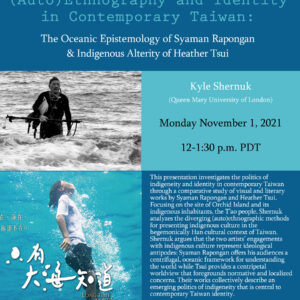
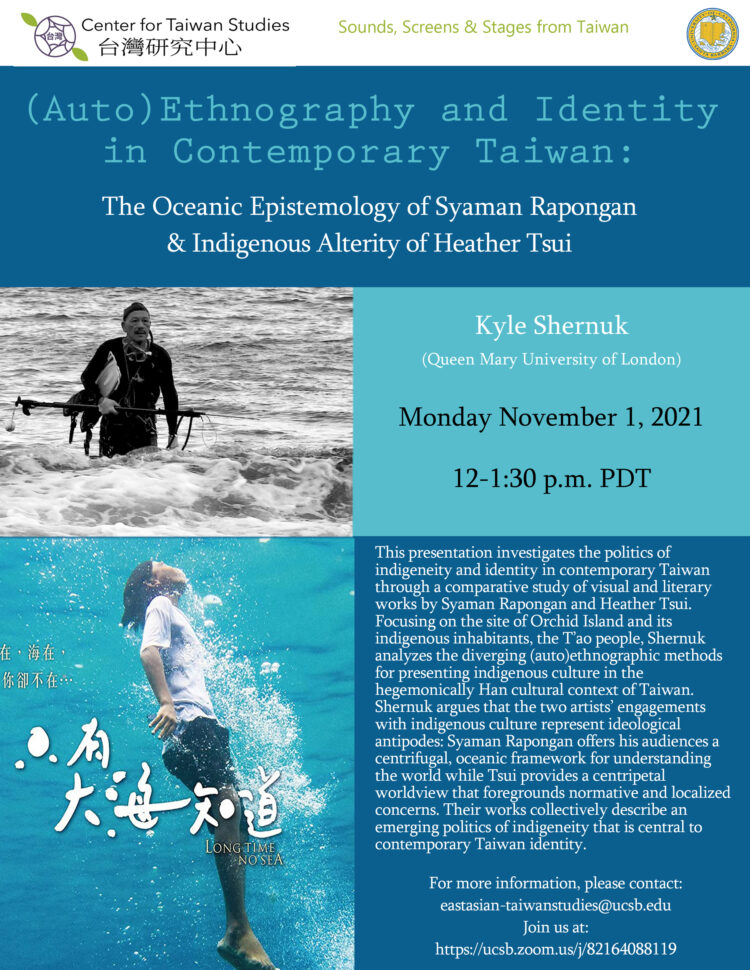
Flyer for Zoom Talk "(Auto)Ethnography and Identity in Contemporary Taiwan: The Oceanic Epistemology of Syaman Rapongan & Indigenous Alterity Heather Tsui" on 11/1/21 from 12-1:30PM PDT

Upcoming Talk: Kyle Shernuk, “(Auto)Ethnography and Identity in Contemporary Taiwan”

As part of the “Sound, Screen, and Stages from Taiwan” series at the Center for Taiwan Studies, we are pleased to welcome Prof. Kyle Shernuk (Queen Mary University of London) to speak on “(Auto)Ethnography and Identity in Contemporary Taiwan: The Oceanic Epistemology of Syaman Rapongan & Indigenous Alterity of Heather Tsui.”

The talk will take place on Monday, November 1, 2021, at 12:00–1:30pm PDT. Join us at: http://ucsb.zoom.us/j/82164088119. For more information, please consult the poster or email eastasian-taiwanstudies@ucsb.edu.

Collage of various pictures during travel

Winni Ni Awarded Takashima Graduate Student Grant

Every year, the Koichi Takashima Graduate Student Grant is given to one of the most promising graduate students in Japanese Cultural Studies. This year, Winni Ni impressed the selection committee with her pursuit of an exceptionally innovative and theoretically sophisticated dissertation titled, “Forms of Relating –The Representation of Intersubjectivity in Contemporary Border-crossing Literature (ekkyō bungaku) in Japan.” Border-crossing literature by contemporary authors who are non-native Japanese speakers, she writes, is commonly known for its polyphonic texts. Scholars have argued that authors create polyphonic texts to mirror and express the multi-lingual identities that resist being pinned down to any given category. This dissertation proposes to radically rethink border-crossing literature by focusing on the representation of relationships between the self and others within a community. Ni examines the narrative’s representations of ways of relating in various border-crossing contexts, exploring how the characters’ self-perceptions are co-constructed with other subjects in the present and in the past. She asks how border-crossing literature represents that process of co-construction using specific rhetorical forms and linguistic expressions, and how it creates a body of knowledge of intersubjective encounters across social, cultural, and linguistic boundaries.

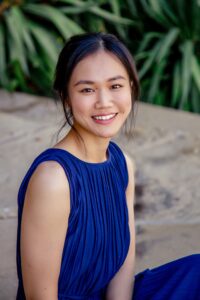
Winni Ni headshot
Winni Ni. Photo Credit to SJP Photography

Through close readings of the border-crossing fictions by Yang Yi (b. 1964), On Yūjū (b. 1980), and Sagisawa Megumu (1968–2004), Ni aims to elucidate the literary rendering of self-emergence through constant and dynamic exchanges with others. She argues that border-crossing literature provides an alternative cultural notion of happiness—one that is grounded in mutual recognition, psychological belonging, and trust. Border-crossing literature achieves this by representing moments of mutual recognition as transformative, enlivening, and deeply pleasurable: they are what the narratives and the characters return to again and again, through highly stylized plots and affectively engaging expressions. Combining literary analysis with psychological and social theories of self-formation, Ni intends to open up new perspectives on Japanese border-crossing literature and to encourage others to use these polyphonic narratives to imagine how individuals could live with their explicit differences—better and together.

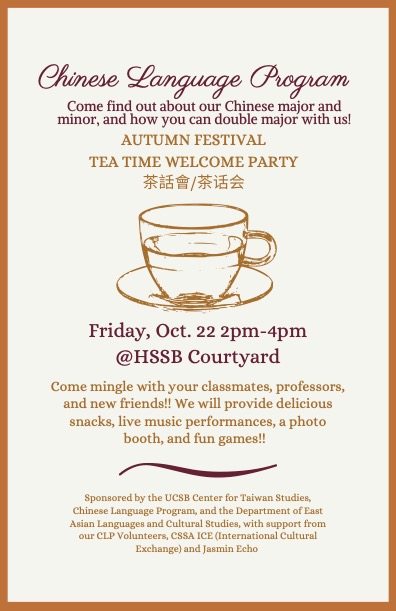
Flyer for "Chinese Language Program, Autumn Festival Tea Time Welcome Party" on 10/22/21 from 2-4PM @ HSSB Courtyard

Tea Time Welcome for Chinese Language Program

Come mingle with your classmates, professors, and new friends!! We will provide delicious snacks, live music performances, a photo booth, and fun games!!

Join us for the Chinese Language Program Autumn Festival Tea Time / Welcome Party!

Friday, Oct. 22 2pm-4pm @HSSB Courtyard

Sponsored by the UCSB Center for Taiwan Studies, Chinese Language Program, and the Department of East Asian Languages and Cultural Studies, with support from our CLP Volunteers, CSSA ICE (International Cultural Exchange) and Jasmin Echo