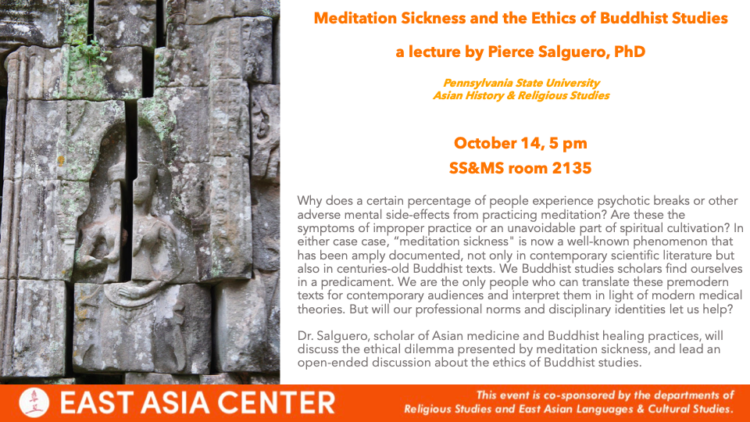
Flyer for "Meditation Sickness and the Ethics of Buddhist Studies" by Pierce Salguero on 10/14/21 at 5PM in SS&MS room 2135

Upcoming Talk by Pierce Salguero: Meditation Sickness and the Ethics of Buddhist Studies

Please join us for the first in-person event of the academic year hosted by the East Asia Center and organized by Dominic Steavu in collaboration with Religious Studies and our department.

Meditation Sickness and the Ethics of Buddhist Studies
a lecture by Pierce Salguero, PhD

October 14, 5pm
Social Science & Media Studies, room 2135

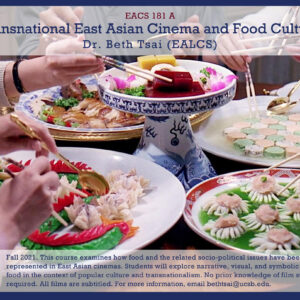
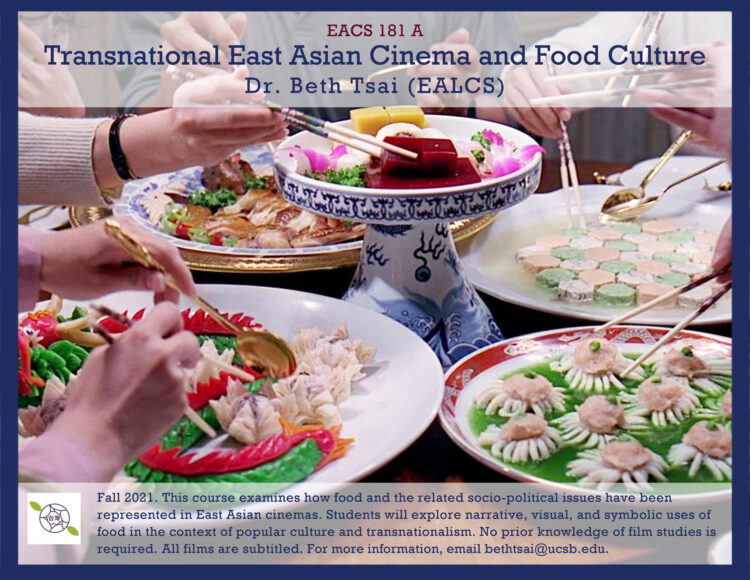
Text describing a course, over an image of several hands holding chopsticks, grabbing food from shared dishes. The text at top reads: EACS 181 A: Transnational East Asian Cinema and Food Culture. Dr. Beth Tsai (EALCS)." Text on bottom reads: "Fall 2021. This course examines how food an the related socio-political issues have been represented in East Asian cinemas. Students will explore narrative, visual, and symbolic uses of food in the context of popular culture and transnationalism. No prior knowledge of film studies is required. All films are subtitled. For more information, email bethtsai@ucsb.edu."

Two New Courses for Fall 2021

This fall, we will be introducing two new courses, both of which are taught by our new colleague, Dr. Beth Tsai (Visiting Assistant Professor of Taiwan Studies).

  • EACS 181A: Transnational East Asian Cinema and Food Culture
  • CHIN 126A: Reading Taiwan Literature

Please see the flyers below for more details.Text describing a course, over an image of several hands holding chopsticks, grabbing food from shared dishes. The text at top reads: EACS 181 A: Transnational East Asian Cinema and Food Culture. Dr. Beth Tsai (EALCS)." Text on bottom reads: "Fall 2021. This course examines how food an the related socio-political issues have been represented in East Asian cinemas. Students will explore narrative, visual, and symbolic uses of food in the context of popular culture and transnationalism. No prior knowledge of film studies is required. All films are subtitled. For more information, email bethtsai@ucsb.edu."

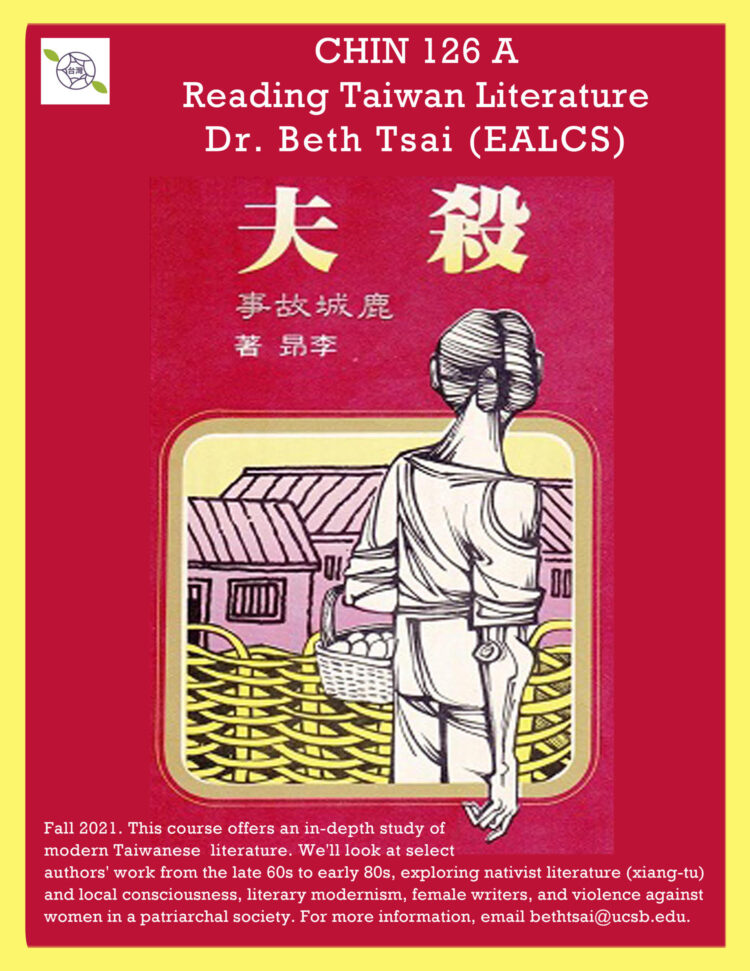
Gold border, red background. Image of a woman standing, facing away, holding a basket and looking at a village. Text at top reads: "CHIN 126 A: Reading Taiwan Literature. Dr. Beth Tsai (EALCS). Several lines in Chinese that give the title and author of a book. Text at bottom reads: "Fall 2021. This course offers an in-depth study of modern Taiwanese literature. We'll look at select authors' work from the late 60s to early 80s, exploring nativist literature (xiang-tu) and local consciousness, literary modernism, female writers, and violence against women in a patriarchal society. For more information, email bethtsai@ucsb.edu."

A close-up photo of Marie Kondo with eyes closed, head slightly bowed, and palms clasped together

Kaitlyn Ugoretz’s Op-Ed on Marie Kondo Featured in Washington Post

A close-up photo of Marie Kondo with eyes closed, head slightly bowed, and palms clasped together
Our very own Kaitlyn Ugoretz‘s op-ed on Marie Kondo has been featured in the Washington Post. Her piece is an insightful analysis into tidiness guru Marie Kondo’s spiritual eclecticism, and what it can tell us about Japanese religion more generally.
Congratulations, Kaitlyn!
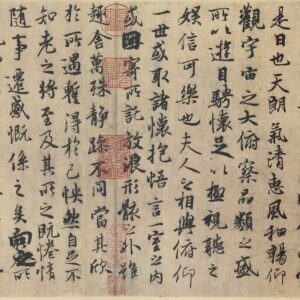
Chinese calligraphy, black ink on beige paper scroll. The text is of "Preface to Lanting Pavilion Collection" by Wang Xizhi.

Classical Chinese Placement Exam (Fall 2021)

The Classical Chinese placement exam is intended for students who have already studied some Classical Chinese (文言) and would like to skip Chinese 101A and enroll directly in Chinese 101B instead. It is offered once per year, administered by Professor Thomas Mazanec. Please email Prof. Mazanec (mazanec@ucsb.edu) if you are interested in taking this exam.

The test will take place on Tuesday, September 28, 3:30–4:30pm (location to be determined). Prof. Mazanec will provide a short passage in Classical Chinese from a Master’s text (like Mencius 孟子, Zhuangzi 莊子, or Hanfeizi 韓非子) and ask students to translate it into English, focusing on the literal meaning of the words and their grammatical relationship to one another. Students may consult a paper dictionary. Prof. Mazanec will provide several copies of Paul Kroll’s A Student’s Dictionary of Classical and Medieval Chinese for reference.

If this time is impossible for you due to scheduling conflicts, please email Prof. Mazanec by Monday, September 27, to make alternative arrangements.
Japanese Language Placement Test for Fall’21


The application period for the placement test Fall’21 has closed. Please check back in November 2021 for the dates of the next Japanese Placement Test in Winter 2022.

If you have any questions, please contact Yoko Yamauchi (yokoy@eastasian.ucsb.edu)

How to prepare for the Placement Test
Review the materials (textbooks) of the course(s) you have taken before. We recommend to review verb and adjective conjugations as well as vocabulary and kanji. Please refer to the course description (Japanese Language Course Description) for more information about the each level of our Japanese courses. If you have a certain course you wish to start, look at the description of the course prior to the placement test. A course description indicates what you are expected to be able to do to take the course you wish to take.

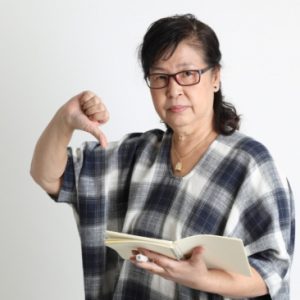
Unhappy woman giving a thumbs down and holding a book

“The Worst Chinese Poetry” featured in The Current

“The Worst Chinese Poetry” event organized by Thomas Mazanec, Xiaorong Li, and Hangping Xu has been featured in the Current, UCSB’s general news outlet. Read the story here: https://www.news.ucsb.edu/2021/020304/lyrical-losers
An excerpt:
“By calling something ‘good,’ you are drawing a line, saying some things are good, some are bad,” Mazanec said. “That line was drawn differently in different times and different places. There are all sorts of considerations that go into drawing that line: aesthetic, moral, social and political standards that change with time. By investigating these standards, we can learn a lot about Chinese literary history.”