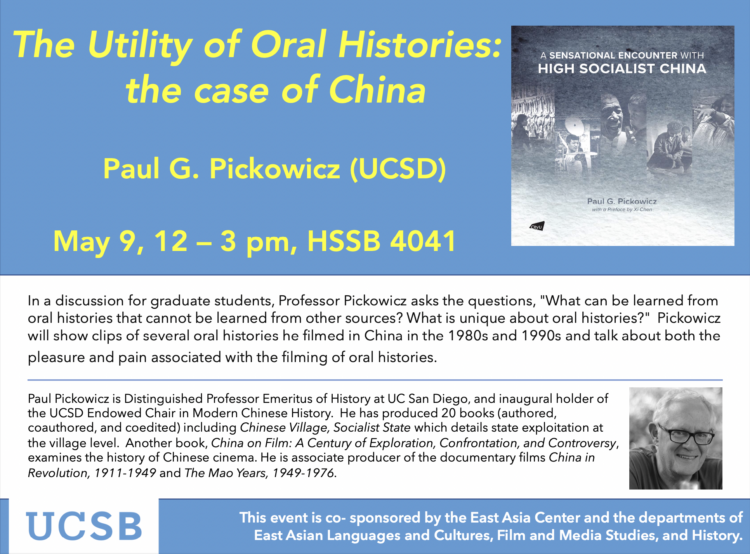
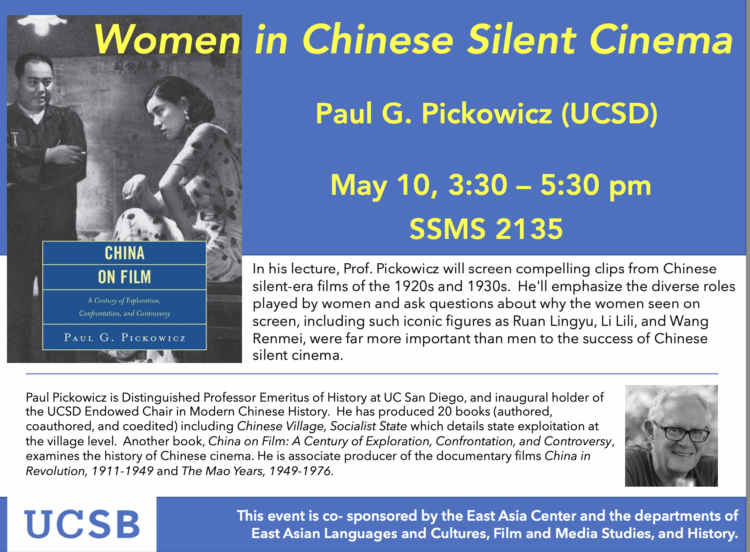
Banner for "The Utility of Oral Histories: the Case of China" by Paul G. Pickowicz on May 9 from 12-3PM in HSSB 4041

The Utility of Oral Histories: The case of China

In a discussion for graduate students, Professor Pickowicz asks the questions, “What can be learned from oral histories that cannot be learned from other sources? What is unique about oral histories?” Pickowicz will show clips of several oral histories he filmed in China in the 1980s and 1990s and talk about both the pleasure and pain associated with the filming of oral histories.

Monday, May 9, 12 – 3 PM, HSSB 4041

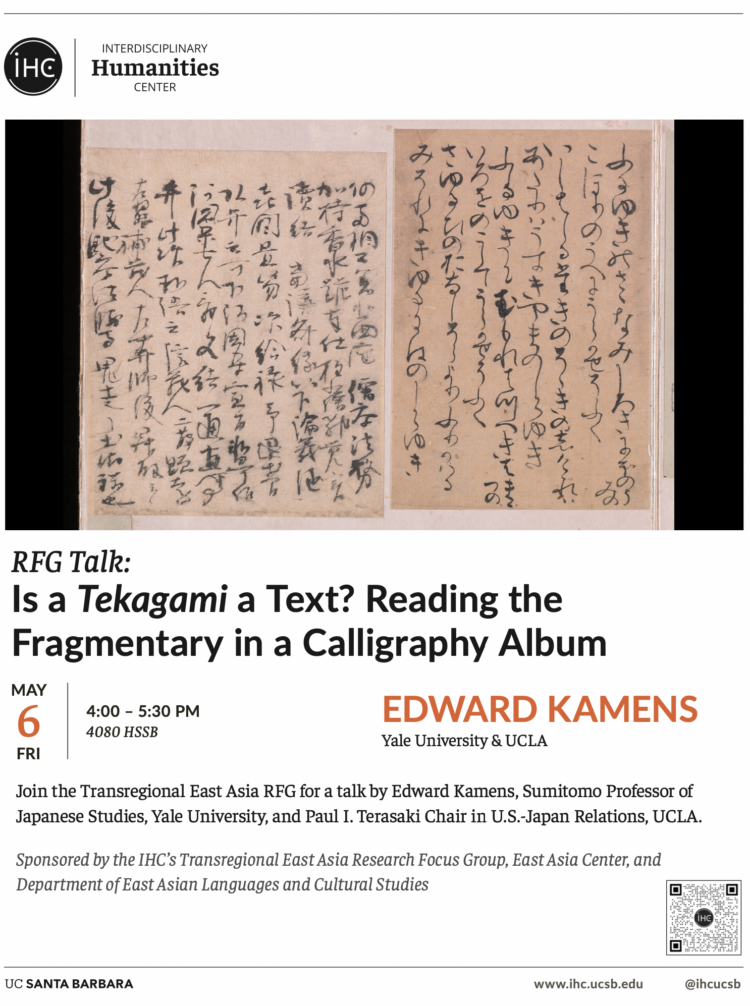
Banner for "RFG Talk: Is a Tekagami a Text? Reading the Fragmentary in a Calligraphy Album

Is a Tekagami a Text? Reading the Fragmentary in a Calligraphy Album

Friday, May 6, HSSB Room 4080, 4 – 5:30 PM

Join the Transregional East Asia RFG for a talk by Edward Kamens, Sumitomo Professor of Japanese Studies, Yale University, and Paul I. Terasaki Chair in U.S.-Japan Relations, UCLA.

Sponsored by the IHC’s Transregional East Asia Research Focus Group, East Asia Center, and Department of East Asian Languages and Cultural Studies

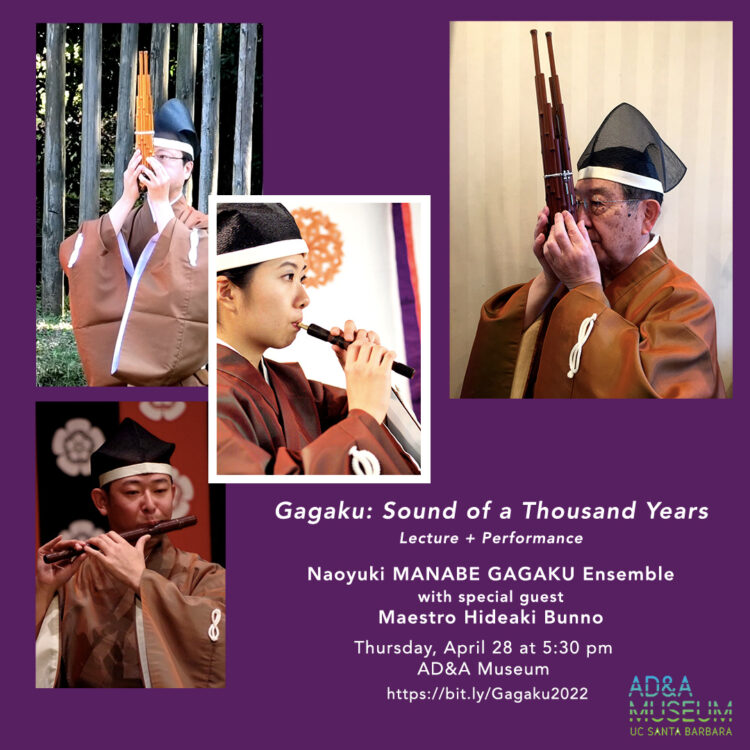
Flyer for Gagaku: Sound of a Thousand Years with Naoyuki Manabe Gagaku Ensemble

Gagaku: Sound of a Thousand Years — Lecture + Performance

Gagaku: Sound of a Thousand Years
Lecture + Performance at UCSB’s ART, DESIGN & ARCHITECTURE MUSEUM
Naoyuki MANABE GAGAKU Ensemble with special guest Maestro Hideaki Bunno
Thursday, April 28 at 5:30 — 7:30 pm
https://bit.ly/Gagaku2022

The Gagaku orchestra at the Imperial Palace of Japan was established in 701; its music is recognized by the government of Japan as a national intangible cultural property, and by UNESCO as part of the intangible cultural heritage of humanity.  The most ancient and continuously performed orchestral tradition in the world, Gagaku is exceptional in its combination of an archaic allure with unexpected contemporary features (free rhythms, complex sound clusters, controlled dissonance). In addition to the imperial court of Japan, Gagaku is also regularly performed at Buddhist temples and Shinto shrines in Japan as part of their respective liturgies.

In this lecture / performance, the musicians will demonstrate the sounds and techniques of their respective instruments and offer the audience a unique perspective on the appreciation of the millenarian world of Gagaku.  This event is organized by Fabio Rambelli (University of California, Santa Barbara) with Naoyuki Manabe, in collaboration with the Art, Design & Architecture Museum at UC Santa Barbara. Generous support is provided by the International Shinto Foundation Endowed Chair in Shinto Studies, UCSB; Robert N.H. Ho Foundation; and Michael Hurley/Manitou Fund.
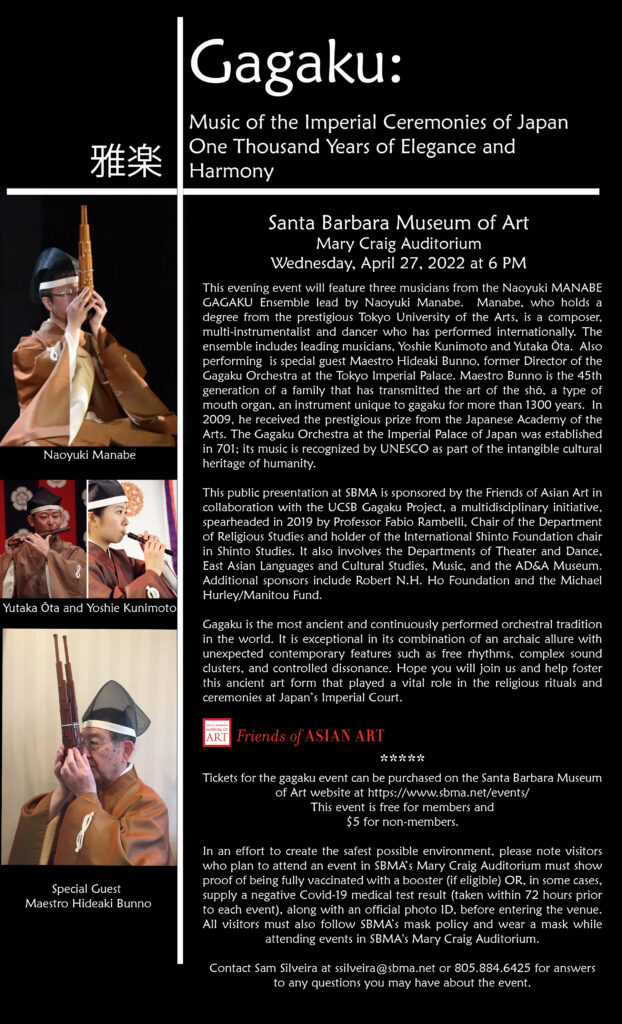
Banner for Gagaku: Music of the Imperial Ceremonies of Japan One Thousand Years of Elegance and Harmony

Gagaku: Music of the Imperial Ceremonies of Japan One Thousand Years of Elegance and Harmony

Santa Barbara Museum of Art, Mary Craig Auditorium
Wednesday, April 27, 2022 at 6 PM

This evening event will feature three musicians from the Naoyuki MANABE GAGAKU Ensemble led by Naoyuki Manabe. Manabe, who holds a degree from the prestigious Tokyo University of the Arts, is a composer, multi-instrumentalist and dancer who has performed internationally. The ensemble includes leading musicians, Yoshie Kunimoto and Yutaka Ota. Also performing is special guest Maestro Hideaki Bunno, former Director of the Gagaku Orchestra at the Tokyo Imperial Palace. Maestro Bunno is the 45th generation of a family that has transmitted the art of the sho, a type of mouth organ, an instrument unique to gagaku for more than 1300 years. In 2009, he received the prestigious prize from the Japanese Academy of the Arts. The Gagaku Orchestra at the Imperial Palace of Japan was established in 701; its music is recognized by UNESCO as part of the intangible cultural heritage of humanity.

Tickets for the gagaku event can be purchased on the Santa Barbara Museum of Art website at https://www.sbma.net/events/  This event is free for members and $5 for non-members.

Banner for Takashima Talks in Japanese Cultural Studies: Spy!, The Hunt for the 'Enemy Within' During the Battle of Okinawa: Rethinking Wartime Atrocities During the Asia-Pacific War

Takashima Talks: SPY! The Hunt for the “Enemy Within” During the Battle of Okinawa


THE HUNT FOR THE “ENEMY WITHIN” DURING THE BATTLE OF OKINAWA: RETHINKING WARTIME ATROCITIES DURING THE ASIA-PACIFIC WAR

This talk will detail the execution of Okinawans as “spies” by the Japanese military during the Battle of Okinawa, which was the last land battle of the Asia-Pacific War, and the one that resulted in the largest number of civilian deaths in the Pacific theater. I will foreground the fear of “spies” throughout the war in general as well as discuss different examples of spy executions, including the killing of children as “spies” in Okinawa. Lastly, I will discuss why these wartime atrocities were never prosecuted as war crimes, either by the Allies or the Japanese. The end of World War Two, the subsequent American occupation of Japan, and the collapse of the Japanese empire were events whose convergence resulted in the destruction of categories like civilian/military and Japanese/colonial. The abrupt dissolution of these categories had wide ranging consequences on how justice and revenge were pursued in the aftermath of the war.

WEDNESDAY, MAY 18, 4:00 — 5:30 PM
HSSB 4080