Announcement of 2021 Annual Meeting for American Oriental Society

EALCS to Host American Oriental Society’s Western Branch Meeting

We are delighted to announce that EALCS will host the Western Branch Meeting of the American Oriental Society on October 21–23, 2021. The meeting will take place online via Zoom. Please see the Call for Papers below for more information.

ANNOUNCEMENT OF THE 2021 ANNUAL MEETING

The 2021 meeting of the American Oriental Society, Western Branch will be hosted virtually via Zoom on October 21–23, 2021 by the Department of East Asian Languages and Cultural Studies at the University of California, Santa Barbara. All members of the AOS are cordially invited and encouraged to attend and to present papers.* Please send by July 31st a title and 250-word abstract of a proposed paper. Abstracts will be evaluated for the command they show of the chosen topic, methodological rigor and originality, clarity and persuasiveness of expression, and the potential contribution of the research to the field. Proposals for exceptional formats such as roundtable discussions or workshops may also be considered. Successful applicants to the conference will be notified by the end of August. Please note that in light of the special constraints of the meeting this year, the number of papers accepted may be lower than usual.

Abstracts should be submitted through the virtual registration portal at https://tinyurl.com/AOSWB2021. Abstracts are due by July 31, 2021. Notifications of decisions on abstracts will be sent out in August 2021.

Accepted papers will have up to 15 minutes for presentation. Final programs will be e-mailed to participants at the end of September. Sessions will be held on three successive days on October 21–23, each session at 1:00 PM5:00 PM PDT. The business meeting will be conducted at 3:00 PM PDT on October 22.

For assistance in planning, all attendees, whether or not presenting a paper, should also register before September 30, 2021 through the virtual registration portal at https://tinyurl.com/AOSWB2021. This year, there is no registration fee for attendees, though presenters should be members of the AOS in good standing. Members who wish to contribute to the Daniel Bryant Memorial Fellowship Fund may send their donations to:

Alexei Ditter, Secretary-Treasurer WBAOS
Eliot 114
3203 Woodstock Boulevard
Portland, OR  97202

Other questions about the meeting may be directed to Thomas Mazanec (mazanec@ucsb.edu).

MEETING ARRANGEMENTS: Given the uncertainty of in-person meetings and international travel in the wake of the COVID-19 pandemic, the conference will be conducted virtually via Zoom.

GRADUATE STUDENT AWARD: In order to encourage graduate students to engage in the activities of the Western Branch, the society in 2015 created the “Graduate Student Travel Award of the American Oriental Society, Western Branch.” This year, at least two awards will again be offered. Awardees will also be honored by special recognition during the conference and on the society’s website. The number of awards in future years will depend on the amount of donations made for this purpose. All applications to the Graduate Student Award will be anonymously reviewed by members of the Executive Committee of the Western Branch.

PRESIDENTIAL ADDRESS: We are glad to announce that the speaker for this year’s guest lecture will be Western Branch president Antje Richter, Associate Professor of Chinese at the University of Colorado, Boulder.

*YOU MUST BE A MEMBER OF THE AMERICAN ORIENTAL SOCIETY TO PRESENT A PAPER AT THE CONFERENCE. Membership information is available in all issues of the Journal of the American Oriental Society and at the American Oriental Society website: https://www.americanorientalsociety.org/.
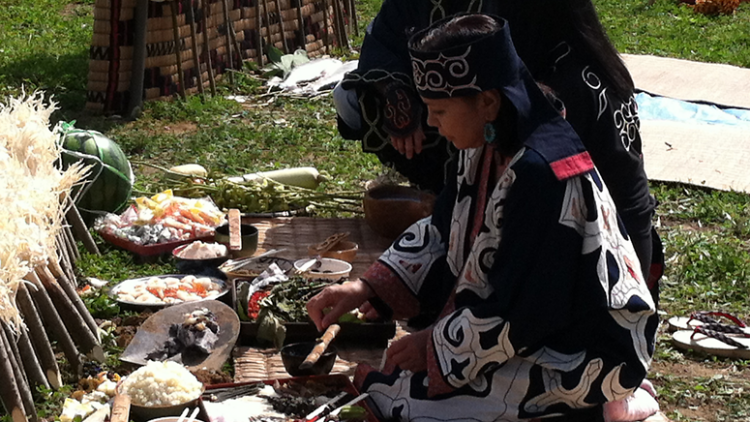
Image of an Ainu woman sitting on a mat outdoors

Faculty Talk: Ainu Indigenous Modernity in Japan: Bringing Our Ancestors Home by Ann-Elise Lewallen

Image of an Ainu woman sitting on a mat outdoors

Join Prof. Ann-Elise Lewallen on Wednesday, February 10, at 5:30pm Pacific Time, as she delivers a guest lecture for the University of San Francisco on “Ainu Indigenous Modernity in Japan: Bringing Our Ancestors Home.” Event Description:

The USF Center for Asia Pacific Studies welcomes Dr. ann-elise lewallen (University of California, Santa Barbara) for an examination of Ainu colonial reckoning and eventual repatriation that unmasks the ongoing violence of settler colonialism in Japan and the ways that honoring kin relations and ancestral places enables a healing process to begin.

In Japan, Ainu experiences of Indigenous modernity have been shaped by a trifecta of settler colonialism, violent interruption of Ainu kin relations with land, and severed kin ties with birth communities due to urbanization and economic pressure. From the mid-19th through 20th century, the Japanese state instituted assimilation policies reinforcing racialization of Ainu bodies as distinct from ethnic Japanese. Thousands of Ainu ancestors were robbed from their resting places to be used for research into “evolutionary origins.” From 2016, while courts ordered repatriation of some ancestral remains, roughly 1,676 Ainu remains were still held in Japanese universities. Meanwhile, in 2020 the Japanese government opened its National Ainu Museum (Upopoy), consolidating all domestic Ainu remains under one roof. Contestations for how ancestors should be memorialized and honored oscillate between two poles. On the one hand, some Ainu communities have employed legal modernity using settler tools like the courts to repatriate ancestors. In contrast, others advocate to continue genetic research on these ancestors and thus boost Ainu indigeneity, which invokes a bio-genetic modernity. This talk explores how Indigenous modernity through bio-genetic tools such as DNA and blood testing has been pitted against legal and political tools of modernity such as backing indigenous sovereignty through the UN Declaration on Indigenous Rights, and centrally, self-determination over Ainu ancestors themselves.

ann-elise lewallen is an engaged anthropologist and Indigenous rights advocate. Her research focuses on aid diplomacy, environmental politics and indigenous sovereignty in contemporary Japan and Asia. In her 2016 book, The Fabric of Indigeneity: Ainu Identity, Gender, and Settler Colonialism in Japan (SAR and UNM Press), lewallen engages with Indigenous Ainu women’s production of textile-based clothwork, arguing that it serves as an idiom of resistance against ongoing Japanese settler colonialism. In her current research, lewallen invokes an environmental justice framework to understand how Indigenous communities use embodied practices and Traditional Ecological Knowledge to shape energy development in Japan and India.

To RSVP, please visit https://www.usfca.edu/event/2021-02-10-1730/ainu-indigenous-modernity-japan-bringing-our-ancestors-home

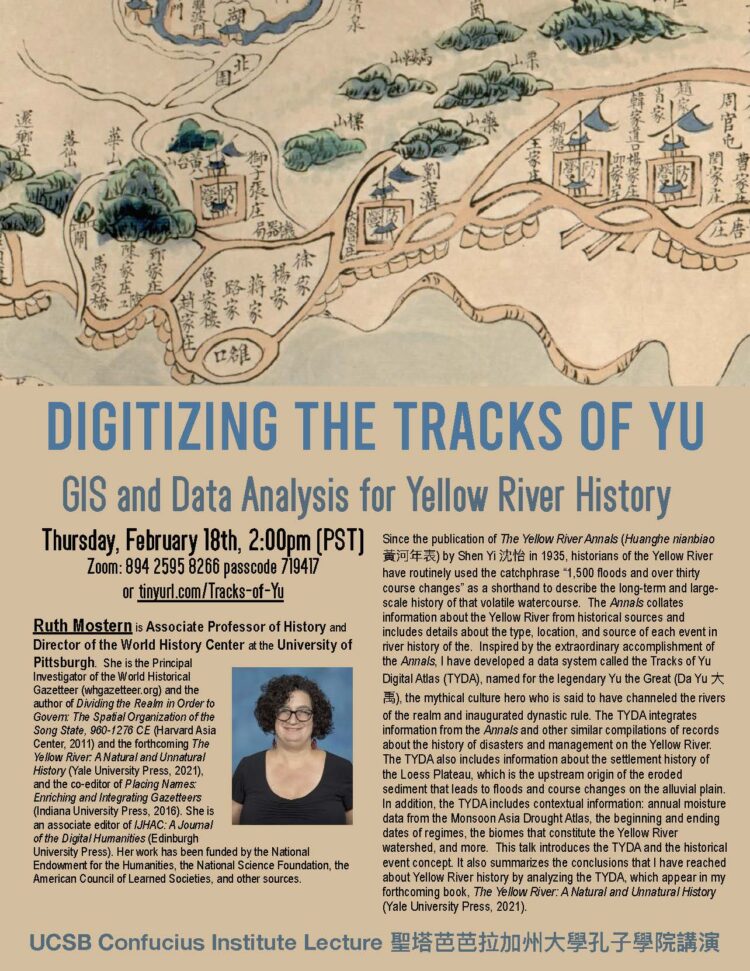
Poster for lecture, "Digitizing the Tracks of Yu" by Dr. Ruth Mostern

“Digitizing the Tracks of Yu” Lecture with Dr. Ruth Mostern, Feb. 18, 2pm

Poster for lecture
Please join us for a lecture with Dr. Ruth Mostern to learn about GIS and data analysis for Yellow River history.
“Digitizing the Tracks of Yu: GIS and Data Analysis for Yellow River History”
Thursday, February 18, 2021    2:00pm (PST)
tinyurl.com/Tracks-of-Yu (Zoom: 894 2595 8266 passcode: 719417)
Since the publication of The Yellow River Annals (Huanghe nianbiao 黃河年表) by Shen Yi 沈怡 in 1935, historians of the Yellow River have routinely used the catchphrase “1,500 floods and over thirty course changes” as a shorthand to describe the long-term and large-scale history of that volatile watercourse.  The Annals collates information about the Yellow River from historical sources and includes details about the type, location, and source of each event in river history of the.  Inspired by the extraordinary accomplishment of the Annals, I have developed a data system called the Tracks of Yu Digital Atlas (TYDA), named for the legendary Yu the Great (Da Yu 大禹), the mythical culture hero who is said to have channeled the rivers of the realm and inaugurated dynastic rule. The TYDA integrates information from the Annals and other similar compilations of records about the history of disasters and management on the Yellow River. The TYDA also includes information about the settlement history of the Loess Plateau, which is the upstream origin of the eroded sediment that leads to floods and course changes on the alluvial plain. In addition, the TYDA includes contextual information: annual moisture data from the Monsoon Asia Drought Atlas, the beginning and ending dates of regimes, the biomes that constitute the Yellow River watershed, and more.  This talk introduces the TYDA and the historical event concept. It also summarizes the conclusions that I have reached about Yellow River history by analyzing the TYDA, which appear in my forthcoming book, The Yellow River: A Natural and Unnatural History (Yale University Press, 2021).
Flyer for "Electric Design: Light, Labor, and Leisure in Prewar Japanese Advertising" featuring Gennifer Weisenfeld from Duke University on 2/24 at 4-5:30Pm

Inaugural Koichi Takashima Lecture: Gennifer Weisenfeld

Please join us for our Inaugural Koichi Takashima Lecture on Wednesday, Feb. 24 at 4:00 PM PST! Featuring the electrifying Gennifer Weisenfeld (Duke University) on “Electric Design: Light, Labor and Leisure in Prewar Japanese Advertising.”
This talk explores the industry’s important cultivation of a nascent consumer market for electrical goods in the prewar period, & the role of graphic design & advertising in aestheticizing, visualizing, & commodifying the seemingly transformative social powers of electric energy.
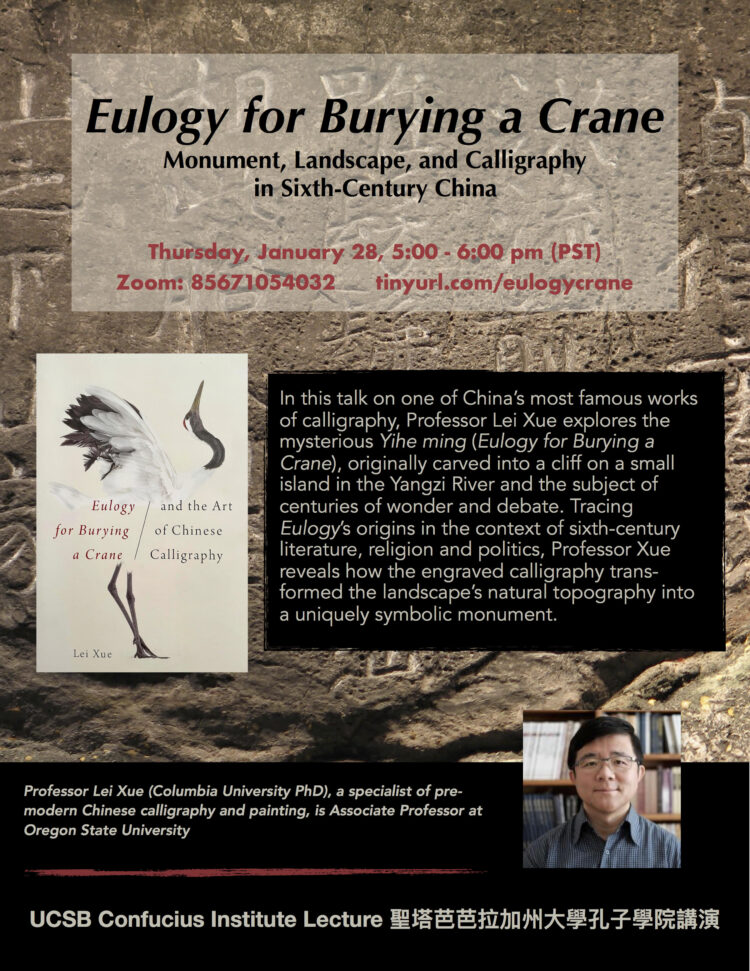
Flyer for "Eulogy for Burying a Crane: Monument, Landscape, and Calligraphy in Sixth Century China" featuring Professor Lei Xue on 1/28 from 5-6PM

Visiting Lecture on Chinese Calligraphy by Prof. Lei Xue

poster for professor xue's talk

On Thursday, January 28, 2021, at 5:00pm (Pacific Time) Prof. Lei Xue of Oregon State University will deliver a lecture on the mysterious Yihe ming 瘞鶴銘 (Eulogy for Burying a Crane) and its significance to the history of Chinese calligraphy. The talk is coordinated with Prof. Peter Sturman’s “Chinese Calligraphy” course (Chinese / Art History 134K) but open to all. Please join us via Zoom at tinyurl.com/eulogycrane.

The talk is sponsored by the UCSB Confucius Institute.