Dear Students,
Happy beginning of fall quarter. My name is Aspen Felt and I’m the coordinator for the Quarter Abroad program in Kyoto through the UC Davis East Asian Languages and Cultures Department. I’m happy to announce that this amazing program is now available to all UC students!
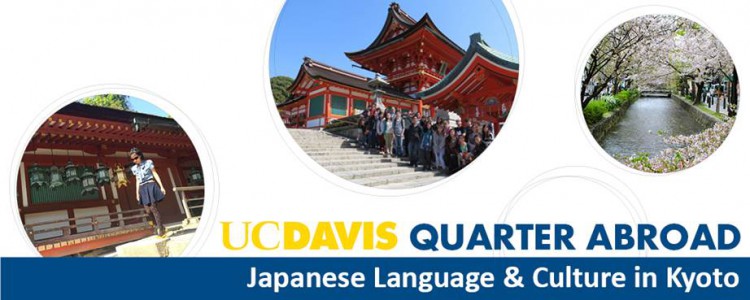
This program takes place in beautiful Kyoto, Japan’s cultural capital. While attending Kyoto Seika University, students will enroll in accelerated language and culture courses, participate in exciting excursions, and spend spring quarter exploring the cultural riches that Kyoto and the surrounding regions have to offer. The program is divided into two levels, consisting of courses for those who have completed Japanese 2 or Japanese 5. In Japan, students will complete an entire year of Japanese in only one quarter.
Enrollment is now open and will remain open until December 4th, 2015.
Program spots are saved on a first completed, first reserved process.
Helpful Contacts for Students
Financial Aid: Financial aid does apply and we recommend that students speak with the financial aid officers at both your home campus and Soua Lo here at UC Davis (sxlo@ucdavis.edu). As part of the process students will need a signature from the home campus financial aid officer, as well as home campus academic advisor.
Intercampus Visitor Process: As part of the enrollment, non-UC Davis students will also complete the Intercampus Visitor program application. More information about this process is available in the online enrollment: https://registrar.ucdavis.edu/registration/special-programs/icv= For additional questions about the enrollment process as a UCLA student, contact Nicole Uhlinger (nmuhlinger@ucdavis.edu)
Program Details: For additional questions about housing, excursions and other program details, contact the program coordinator and advisor, Aspen Felt (alfelt@ucdavis.edu).
Academics: This program carries a total of 18-22 quarter units. For questions about the classes taught on this program, you can contact the UC Davis Quarter Abroad Kyoto faculty leader, Joseph Sorensen (jsorensen@ucdavis.edu ). Course information and prerequisite equivalents can be found here.
I am also available for individual student appointments to discuss the program and answer any additional questions via email or over the phone.I hope to hear from you soon!
Sincerely,
Aspen Felt | Program Services Coordinator
UC Davis Study Abroad
University of California, Davis
207 Third Street, Suite 120 | Davis, CA 95616 U.S.A.
Phone: 530.297.4420 | Email: alfelt@ucdavis.edu
Homepage: http://studyabroad.ucdavis.edu | Staff Profile
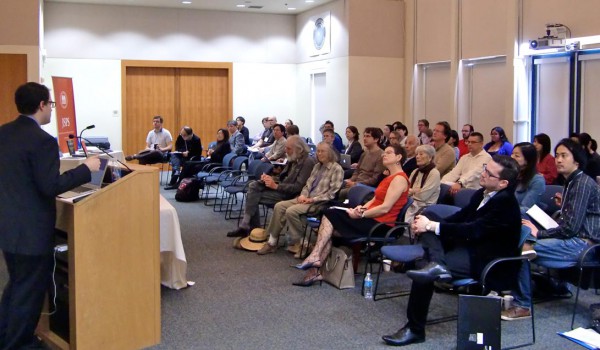
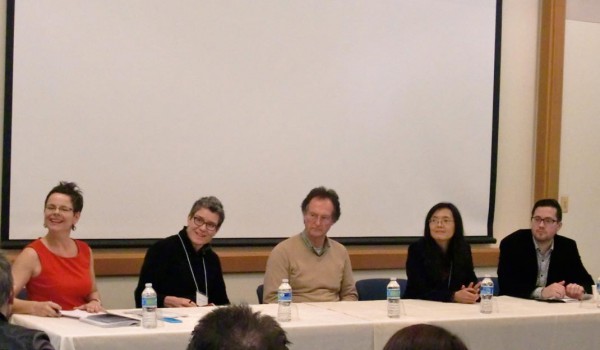
 (Santa Barbara, Calif.) — For people who have been connected to the land it comes from for thousands of years, food is more than just a collection of calories and nutrients. For Native Americans, traditional staples can define their identity and represent their relationship to the earth, wind and sky. This point, so often lost in an age when processed foods and foods traveling long distances are commonplace, was driven home in a symposium on native food ways, biocolonialism and environmentalism. The conference at UC Santa Barbara was the first of its kind, and brought together scholars and students who approached the topic of food and indigenous culture from different perspectives. The symposium was sponsored by the American Indian & Indigenous Collective (AIIC) Research Focus Group at UCSB.