The Confucius Institute website has just launched, be sure to check back often for news and events!
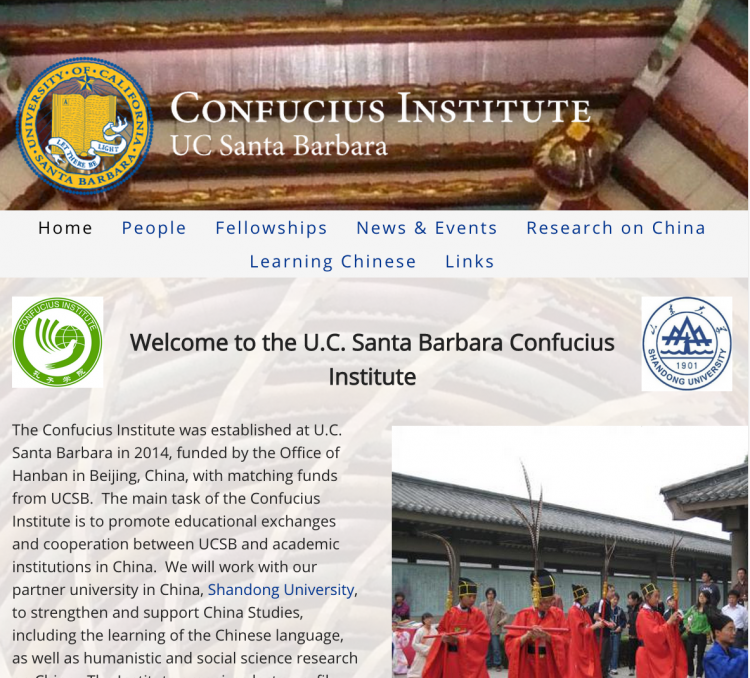
The Confucius Institute website has just launched, be sure to check back often for news and events!

Sabine Frühstück organizes conference, Child’s Play: Multisensory Histories of Children and Childhood in Japan and Beyond, February 27-28, 2015.
 We congratulate EALCS affiliate, Professor David Novak! Novak’s podcast and website “Sounds of Japan’s Antinuclear Movement” received an honorable mention, 2014 Plath Media Award, Society for East Asian Anthropology.
The Office of Hanban, the Beijing headquarters of Confucius Institutes around the world, offers fellowships for Ph.D. students to study for one or more years in China. The Study in China Ph.D. Fellowship allows for students who will receive their Ph.D. at UCSB, and the Sino-foreign Joint Research Ph.D. Fellowship provides for a joint Ph.D., where a student also gets a Ph.D. at a Chinese research university.
Click on each for more information:
Sino-foreign Joint Research Ph.D. FellowshipSupport doctoral students (candidates) registered with foreign universities to come to China for study, research and writing of their doctoral dissertations.
From six months to two years.
The Confucius China Studies Program Expert Committee will review the application materials and conduct video interview.
Study in China Ph.D. Fellowship
Support foreign students to pursue full-time Ph.D. degrees in the humanities and social sciences at Chinese universities.
The Confucius China Studies Program Expert Committee will review the application materials and conduct video interview.
Applicants shall submit the online application at https://www.iie.org/programs/confucius-china-studies-program, and then post the application forms and other supporting documents to the Confucius Institute Headquarters.
A student may study at any qualified research university in China, or at Shandong University in Jinan City, Shandong Province, which is the partner university of UCSB Confucius Institute. If a student wishes to go study at Shandong University for one or more years, download this list of Research Faculty @ Shandong University.xslx and their areas of expertise.
Download the list of 100 Research Topics and areas of research that can be funded.
The applicant shall submit the online application, and then post the application form and other supporting documents to the Confucius Institute Headquarters.
The online application system will be closed on January 31st, 2015, at 23:59 (BeiJing time).
We will review the application materials and conduct video interviews with shortlisted applicants. Please feel free to let us know if you have any inquiry or concern:
Office of Confucius Institute The recent issue of The Medieval History Journal on “The Literary Subversive: Writings of Resistance in East Asian History,” edited by EALCS Professor Dominic Steavu, has just been published. This is the first time the flagship journal devoted an entire issue to East Asia. Collectively, the volume’s authors probe the roles of intellectuals in social and political resistance to hegemonic ideologies.
Challenging western theories of the role of intellectuals, the essays in the volume offer a range of East Asian perspectives. In addition to Professor Steavu’s visionary introductory essay on “The Literary Subversive: Writings of Resistance in East Asian History” and another article on “Cosmogony and the Origin of Inequality: A Utopian Perspective from Taoist Sources,” EALCS Professor Fabio Rambelli contributed, “The Vicissitudes of the Mahāsammata in East Asia: The Buddhist Origin Myth of Kingship and Traces of a Republican Imagination.” Other contributions include James A. Benn’s on “Self-immolation, Resistance and Millenarianism in Medieval Chinese Buddhism,” Gil Raz’s “‘Conversion of the Barbarians’ Discourse as Proto Han Nationalism,” Ari Daniel Levine’s “Stages of Decline: Cultural Memory, Urban Nostalgia and Political Indignation as Imaginaries of Resistance in Yue Ke’s Pillar Histories,” and Grégoire Espesset’s “Local Resistance in Early Medieval Chinese Historiography and the Problem of Religious Overinterpretation.”
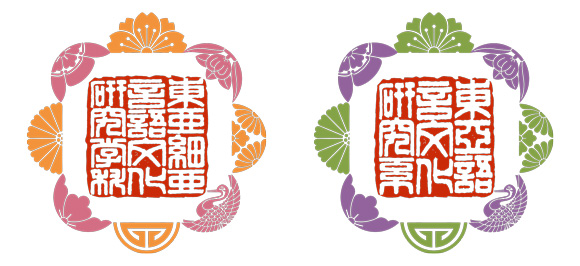
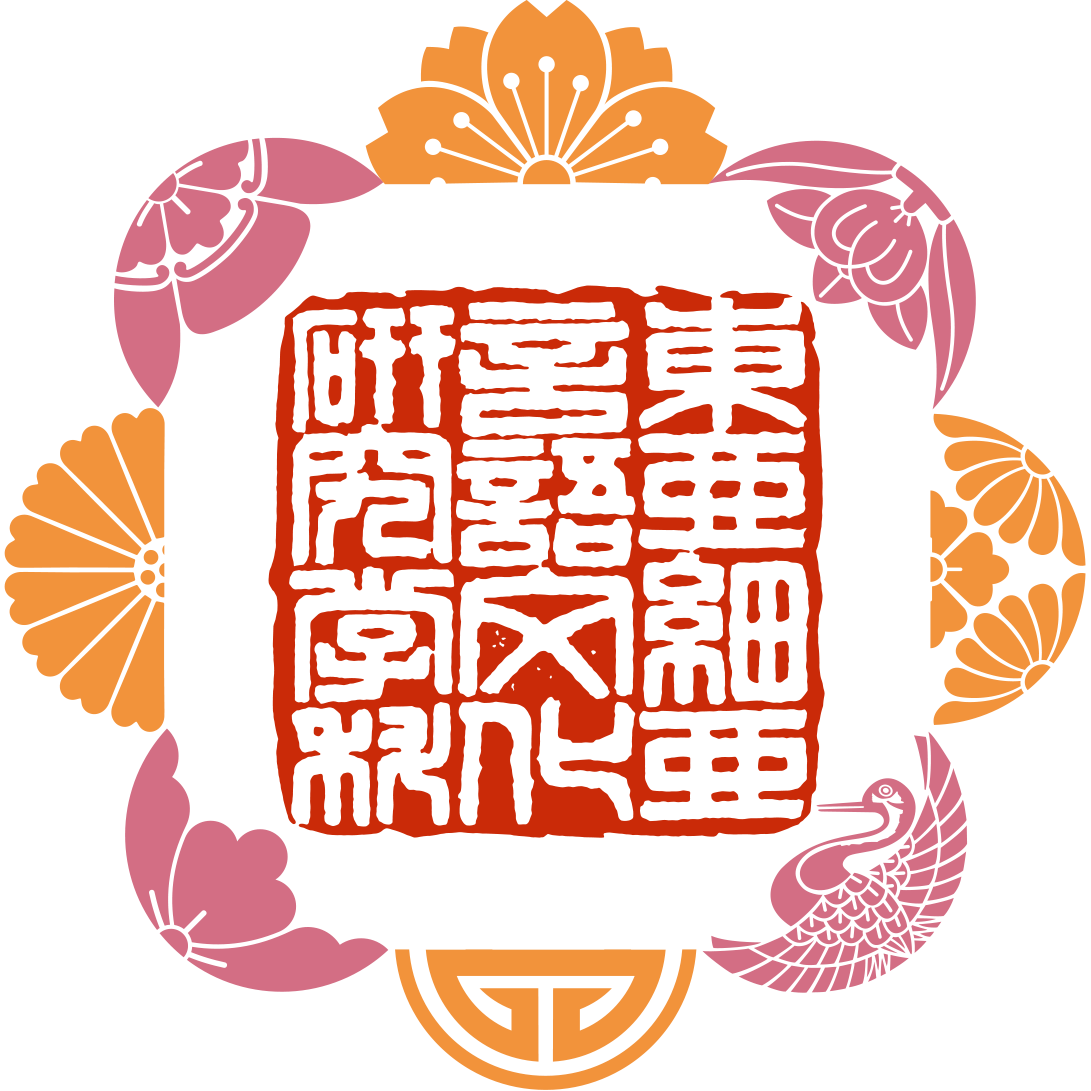
One of the Japan’s leading graphic designers, Terashima Masayuki, has created a new logo for our department. The decorative patterns are modeled on early modern Japanese family crests (kamon), with elements from Japanese and Chinese traditional design. The logo comes in two variants, one in Chinese and the other in Japanese (both with characters written in the ancient seal style), to represent figuratively the two countries’ shared heritage and their cultural differences.
Mr. Terashima gifted the logo to the department.
Links to Terashima Masayuki’s own websites:
http://www.tera-d.net/works/
http://www.tera-d.net/
Download the logos here: