
black ink splotches on a white paper

New Book by Prof. Thomas Mazanec: Poet-Monks

Book cover for "Poet-Monks: The Invention of Buddhist Poetry in Late Medieval China" by Thomas J. Mazanec

Prof. Thomas Mazanec’s book, Poet-Monks: The Invention of Buddhist Poetry in Late Medieval China, is now available from Cornell University Press.

Poet-Monks focuses on the literary and religious practices of Buddhist poet-monks in Tang-dynasty China to propose an alternative historical arc of medieval Chinese poetry. Combining large-scale quantitative analysis with close readings of important literary texts, Thomas J. Mazanec describes how Buddhist poet-monks, who first appeared in the latter half of Tang-dynasty China, asserted a bold new vision of poetry that proclaimed the union of classical verse with Buddhist practices of repetition, incantation, and meditation.

Mazanec traces the historical development of the poet-monk as a distinct actor in the Chinese literary world, arguing for the importance of religious practice in medieval literature. As they witnessed the collapse of the world around them, these monks wove together the frayed threads of their traditions to establish an elite-style Chinese Buddhist poetry. Poet-Monks shows that during the transformative period of the Tang-Song transition, Buddhist monks were at the forefront of poetic innovation.

You can download an open-access digital edition for free here, or you can purchase a physical copy from the publisher’s website (30% off with code 09BCARD).

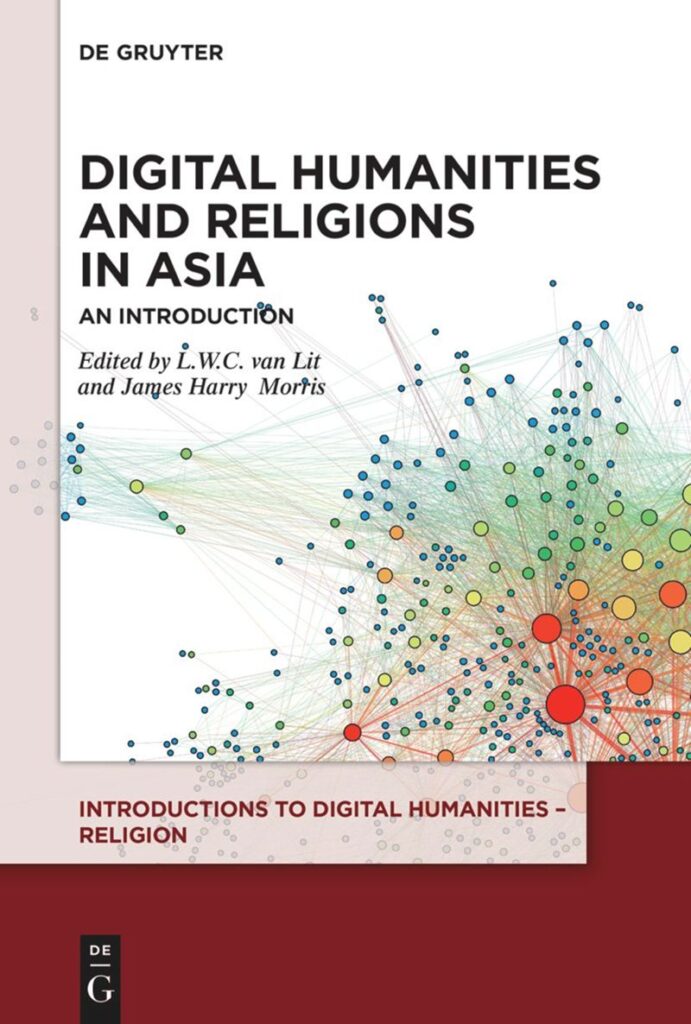
Book Cover for "Digital Humanities and Religions in Asia, An Introduction" edited by L.W.C van Lit and James Harry Morris

PhD Candidate Kaitlyn Ugoretz Publishes on Shinto, Material Religion, & Algorithms

PhD Candidate Kaitlyn Ugoretz has published a chapter on her research into global Shinto communities in a new volume, Digital Humanities and Religions in Asia, edited by L.W.C. van Lit and James Harry Morris (De Gruyter 2023). The volume explores the limitations and potential opportunities of applying a digital humanities approach to pre-modern Asian religions. Ugoretz’s chapter, “Consuming Shinto, Feeding the Algorithm,” analyzes the impact of social media software on digital habitus and global religious aesthetic formations through a case study of posting practices relating to domestic altars in digital Shinto communities on Facebook.

Congrats, Kaitlyn!

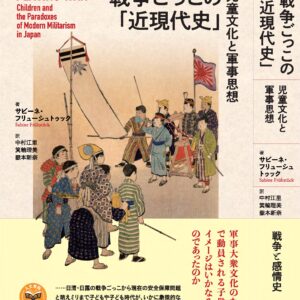
Book Cover for "Playing War: Children and the Paradoxes of Modern Militarism in Japan" by Sabine Frühstück

New Japanese translation of Prof. Sabine Frühstück’s book Playing War

The Japanese translation of Sabine Frühstück’s book, Playing War (University of California Press, 2017) is now out from Jinbun Shōbo, Kyoto, 2023. 『「戦争ごっこ」の近現代史—児童文化と軍事思想』Joanna Bourke found that it “evokes a world of militarized children enticed into war not only because of the needs of empire, education, and discipline, but also because of the pleasure of play. It uncovers the subtle ways that the image of the child was placed at the forefront of Japanese war rhetoric and practice. By weaving together histories of war, the emotions, and childhood, Frühstück has produced a riveting account of everyday life in Japan.”

artwork for Fleming's Strange Tales from Edo

New Book by Professor William Fleming: Strange Tales from Edo

New Book by Professor William Fleming: Strange Tales from Edo: Rewriting Chinese Fiction in Early Modern Japan (Harvard University Asia Center, 2023).

Strange Tales from Edo paints a sweeping picture of Japan’s engagement with Chinese fiction in the early modern period (1600–1868). Large-scale analyses of the full historical and bibliographical record—the first of their kind—document in detail the wholesale importation of Chinese fiction, the market for imported books and domestic reprint editions, and the critical role of manuscript practices—the ascendance of print culture notwithstanding—in the circulation of Chinese texts among Japanese readers and writers.

Bringing this big picture to life, Fleming also traces the journey of a text rarely mentioned in studies of early modern Japanese literature: Pu Songling’s Liaozhai zhiyi (Strange Tales from Liaozhai Studio). An immediate favorite of readers on the continent, Liaozhai was long thought to have been virtually unknown in Japan until the modern period. Copies were imported in vanishingly small numbers, and the collection was never reprinted domestically. Yet beneath this surface of apparent neglect lies a rich hidden history of engagement and rewriting—hand-copying, annotation, criticism, translation, and adaptation—that opens up new perspectives on both the Chinese strange tale and its Japanese counterparts.

grainy black and white photo of a group of men holding guns

Hanne Deleu Publishes Book Chapter: “Sagas of Swords, Scrolls, and Dolls: Japanese Humanitarian Aid to Belgium”

Congratulations to graduate student Hanne Deleu for publishing her book chapter “Sagas of Swords, Scrolls, and Dolls: Japanese Humanitarian Aid to Belgium” in the edited volume titled Humanitarianism and the Greater War, 1914–24. Click the image above or the citation below to read her work.
Citation:
Deleu, Hanne. “Sagas of Swords, Scrolls, and Dolls: Japanese Humanitarian Aid to Belgium.” In Humanitarianism and the Greater War, 1914–24, edited by Elisabeth Piller and Neville Wylie, 51–68. Manchester: Manchester University Press, 2023. https://doi.org/10.7765/9781526173256. Hanne Deleu_Sagas of Swords, Scrolls, and Dolls: Japanese Humanitarian Aid to Belgium_2023