Koichi Takashima Lecture in Japanese Cultural Studies 2022: Tawada Yoko: Translation as Politics, Translation as Dream

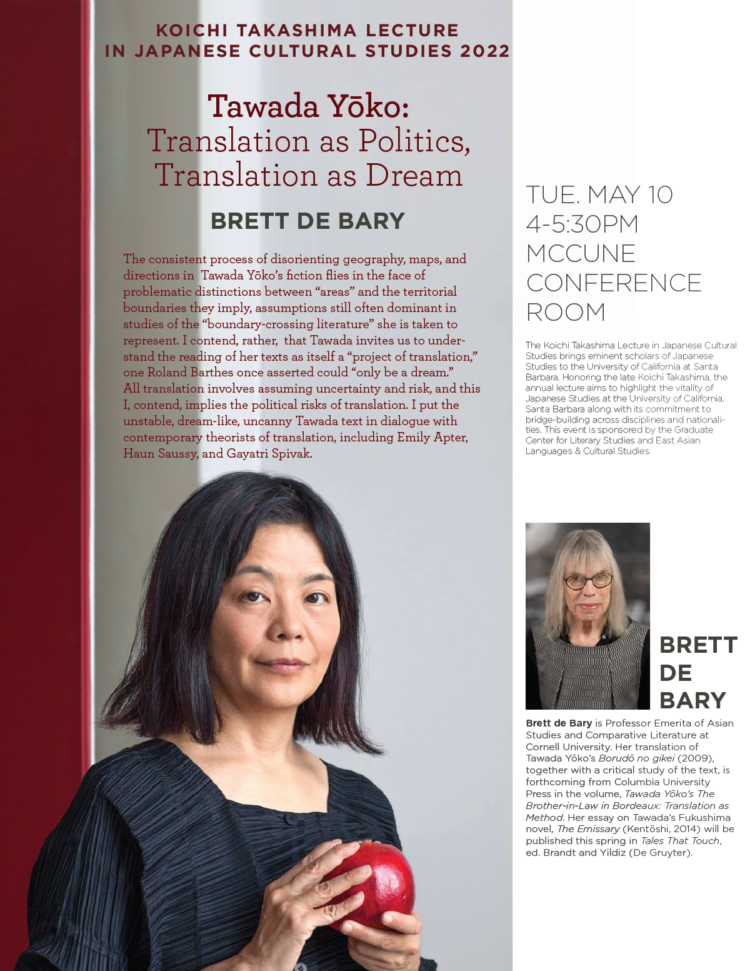
Koichi Takashima Lecture 2022: Tawada Yōko — Translation as Politics, Translation as Dream

Koichi Takashima Lecture 2022: Tawada Yōko — Translation as Politics, Translation as Dream

The consistent process of disorienting geography, maps, and directions in Tawada Yōko’s fiction flies in the face of problematic distinctions between “areas” and the territorial boundaries they imply, assumptions still often dominant in studies of the “boundary-crossing literature” she is taken to represent. I contend, rather, that Tawada invites us to understand the reading of her texts as itself a “project of translation,” one Roland Barthes once asserted could “only be a dream.” All translation involves assuming uncertainty and risk, and this I, contend, implies the political risks of translation. I put the unstable, dream-like, uncanny Tawada text in dialogue with contemporary theorists of translation, including Emily Apter, Haun Saussy, and Gayatri Spivak.

Brett de Bary is Professor Emerita of Asian Studies and Comparative Literature at Cornell University. Her translation of Tawada Yōko’s Borudò no gikei (2009), together with a critical study of the text, is forthcoming from Columbia University Press in the volume. Tawada Yōko’s The Brother-in-Law in Bordeaux: Translation as Method.  Her essay on Tawada’s Fukushima novel, The Emissarv (Kentöshi, 2014) will be published this spring in Tales That Touch, ed. Brandt and Yildiz (De Gruyter)

TUESDAY, MAY 10, 4 — 5:30P M
UCSB:  MCCUNE CONFERENCE ROOM

Banner for Takashima Talks in Japanese Cultural Studies: The Democracy that Society Allows, Protest Sounds Japan and the US

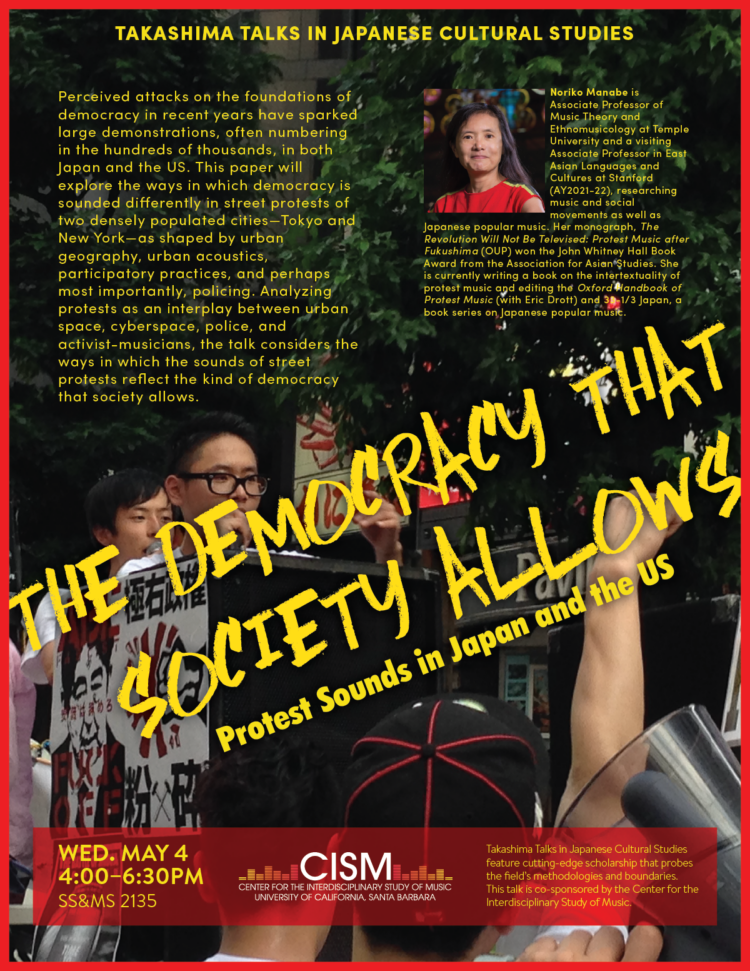
Takashima Talks: The Democracy That Society Allows — Protest Sounds in Japan and the US

Takashima Talks: The Democracy That Society Allows — Protest Sounds in Japan and the US

Perceived attacks on the foundations of democracy in recent years have sparked large demonstrations, often numbering in the hundreds of thousands, in both Japan and the US. This paper will explore the ways in which democracy is sounded differently in street protests of two densely populated cities-Tokyo and New York-as shaped by urban geography, urban acoustics, participatory practices, and perhaps most importantly, policing. Analyzing protests as an interplay between urban space, cyberspace, police, and activist-musicians, the talk considers the ways in which the sounds of street protests reflect the kind of democracy that society allows.

WEDNESDAY, MAY 4, 4:00 — 6:30 PM
UCSB Campus:  SS&MS 2135

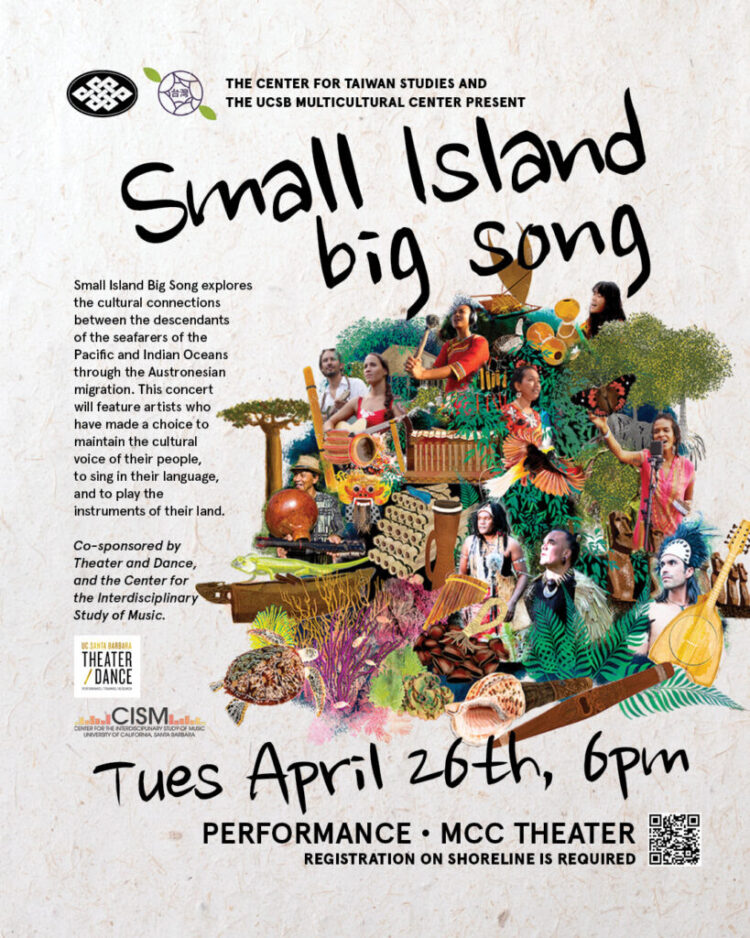
Banner for Small Island, Big Song

Small Island BIG Song Performance at MCC Theater

Small Island Big Song explores the cultural connections between the descendants of the seafarers of the Pacific and Indian Oceans through the Austronesian migration. This concert will feature artists who have made a choice to maintain the cultural voice of their people, to sing in their language, and to play the instruments of their land.

Tuesday, April 26, 6 PM PST, UCSB MCC Theater

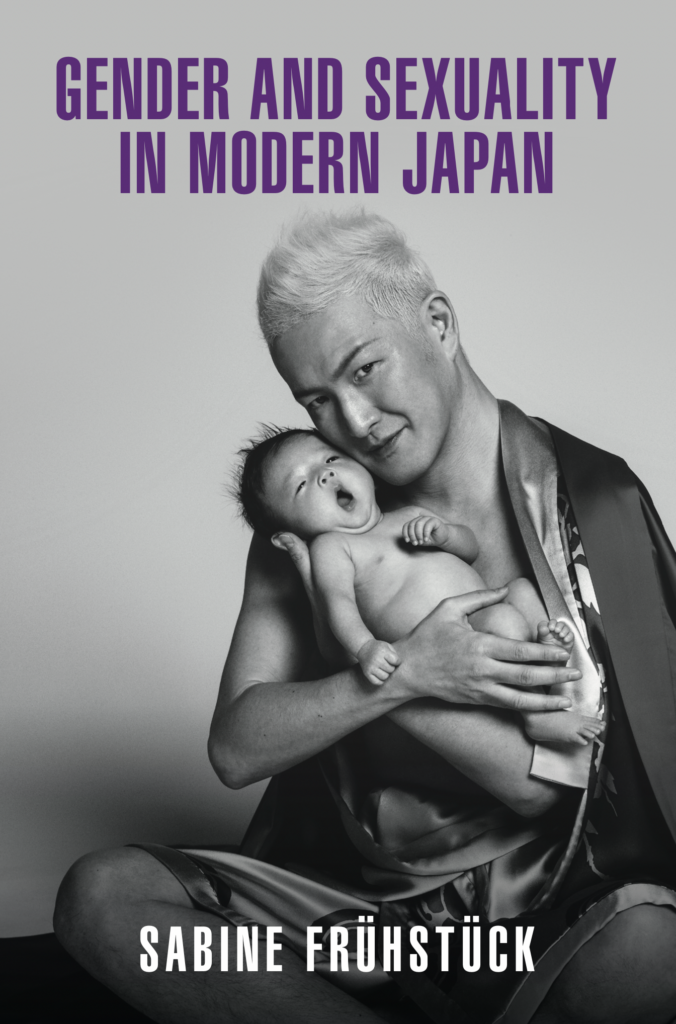
Book Cover for Gender and Sexuality in Modern Japan by Sabine Fruhstuck

Sabine Frühstück’s New Book Published: “Gender and Sexuality in Modern Japan”

Congratulations to Professor Sabine Frühstück for publishing her new book, Gender and Sexuality in Modern Japan, Cambridge University Press, 2022.

Gender and Sexuality in Modern Japan describes the ever-changing manifestations of sexes, genders, and sexualities in Japanese society from the 1860s to the present day. Analysing a wide range of texts, images and data, Sabine Frühstück considers the experiences of females, males and the evolving spectrum of boundary-crossing individuals and identities in Japan.

To learn more about the book, please read this wonderful blog post by Professor Frühstück by clicking HERE.

Reviews & Endorsements

“Encompassing the full sweep of modern history, and drawing upon the tools of multiple disciplines, this broad ranging and deeply insightful book is essential reading for anyone interested in what Japan has to teach us about the ways in which questions of sex, gender, and sexuality define our world and its possibilities.”  ~~ Daniel Botsman, Yale University

“Frühstück’s keen historiographic eye along with her deep knowledge of literature and visual culture combine to make this book a must-read for anyone interested in the broader landscape of gender and sexuality in Japan. It is truly a tour de force.”  ~~ Glenda Roberts, Waseda University

Book cover for "Cultural Imprints: War and Memory in the Samurai Age" edited by Elizabeth Oyler and Katherine Saltzman-Li

Congratulations to Kate Saltzman-Li on Her New Co-Edited Volume, “Cultural Imprints”!

Congratulations to Professor Kate Saltzman-Li on her new co-edited volume, Cultural Imprints:  War And Memory In The Samurai Age!

Cultural Imprints draws on literary works, artifacts, performing arts, and documents that were created by or about the samurai to examine individual “imprints,” traces holding specifically grounded historical meanings that persist through time. The contributors to this interdisciplinary volume assess those imprints for what they can suggest about how thinkers, writers, artists, performers, and samurai themselves viewed warfare and its lingering impact at various points during the “samurai age,” the long period from the establishment of the first shogunate in the twelfth century through the fall of the Tokugawa in 1868.

The range of methodologies and materials discussed in Cultural Imprints challenges a uniform notion of warrior activity and sensibilities, breaking down an ahistorical, monolithic image of the samurai that developed late in the samurai age and that persists today. Highlighting the memory of warfare and its centrality in the cultural realm, Cultural Imprints demonstrates the warrior’s far-reaching, enduring, and varied cultural influence across centuries of Japanese history.

Contributors: Monica Bethe, William Fleming, Andrew Goble, Thomas Hare, Luke Roberts, Marimi Tateno, Alison Tokita, Elizabeth Oyler, Katherine Saltzman-Li

White text on red background reading "Global Shinto with Kaitlyn Ugoretz." Below are three circles with a Shinto priest on a laptop screen, headshot of Ugoretz, and a photo of torii gates. At the bottom are logos of sponsors.

Kaitlyn Ugoretz interviewed about Global Shinto for Beyond Japan Podcast


White text on red background reading "Global Shinto with Kaitlyn Ugoretz." Below are three circles with a Shinto priest on a laptop screen, headshot of Ugoretz, and a photo of torii gates. At the bottom are logos of sponsors.

EALCS Ph.D. candidate Kaitlyn Ugoretz recently sat down with the Beyond Japan podcast to discuss the global appeal of Shinto in the digital era. Kaitlyn introduces online Shinto communities as old as the internet itself, as well as the many international faces of Shinto, from official shrines in the USA to localised rituals and Marie Kondo’s brand of spiritualism. Click here to stream the podcast, or find it on your favorite podcast app.