Banner for Takashima Talks in Japanese Cultural Studies: Spy!, The Hunt for the 'Enemy Within' During the Battle of Okinawa: Rethinking Wartime Atrocities During the Asia-Pacific War

Takashima Talks: SPY! The Hunt for the “Enemy Within” During the Battle of Okinawa


THE HUNT FOR THE “ENEMY WITHIN” DURING THE BATTLE OF OKINAWA: RETHINKING WARTIME ATROCITIES DURING THE ASIA-PACIFIC WAR

This talk will detail the execution of Okinawans as “spies” by the Japanese military during the Battle of Okinawa, which was the last land battle of the Asia-Pacific War, and the one that resulted in the largest number of civilian deaths in the Pacific theater. I will foreground the fear of “spies” throughout the war in general as well as discuss different examples of spy executions, including the killing of children as “spies” in Okinawa. Lastly, I will discuss why these wartime atrocities were never prosecuted as war crimes, either by the Allies or the Japanese. The end of World War Two, the subsequent American occupation of Japan, and the collapse of the Japanese empire were events whose convergence resulted in the destruction of categories like civilian/military and Japanese/colonial. The abrupt dissolution of these categories had wide ranging consequences on how justice and revenge were pursued in the aftermath of the war.

WEDNESDAY, MAY 18, 4:00 — 5:30 PM
HSSB 4080

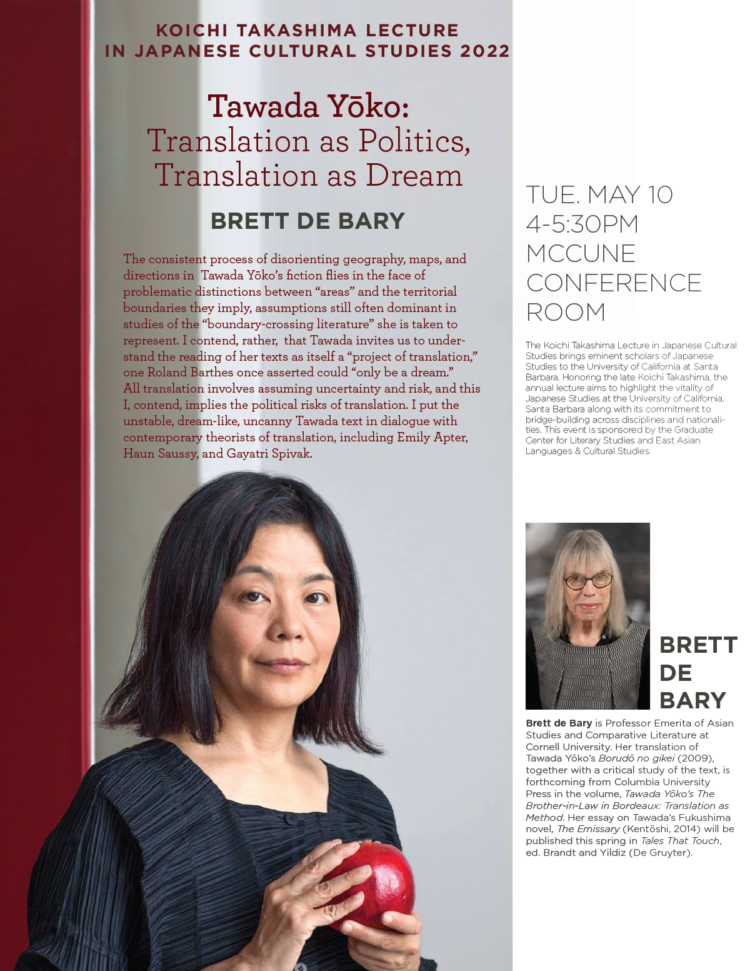
Koichi Takashima Lecture in Japanese Cultural Studies 2022: Tawada Yoko: Translation as Politics, Translation as Dream

Koichi Takashima Lecture 2022: Tawada Yōko — Translation as Politics, Translation as Dream

Koichi Takashima Lecture 2022: Tawada Yōko — Translation as Politics, Translation as Dream

The consistent process of disorienting geography, maps, and directions in Tawada Yōko’s fiction flies in the face of problematic distinctions between “areas” and the territorial boundaries they imply, assumptions still often dominant in studies of the “boundary-crossing literature” she is taken to represent. I contend, rather, that Tawada invites us to understand the reading of her texts as itself a “project of translation,” one Roland Barthes once asserted could “only be a dream.” All translation involves assuming uncertainty and risk, and this I, contend, implies the political risks of translation. I put the unstable, dream-like, uncanny Tawada text in dialogue with contemporary theorists of translation, including Emily Apter, Haun Saussy, and Gayatri Spivak.

Brett de Bary is Professor Emerita of Asian Studies and Comparative Literature at Cornell University. Her translation of Tawada Yōko’s Borudò no gikei (2009), together with a critical study of the text, is forthcoming from Columbia University Press in the volume. Tawada Yōko’s The Brother-in-Law in Bordeaux: Translation as Method.  Her essay on Tawada’s Fukushima novel, The Emissarv (Kentöshi, 2014) will be published this spring in Tales That Touch, ed. Brandt and Yildiz (De Gruyter)

TUESDAY, MAY 10, 4 — 5:30P M
UCSB:  MCCUNE CONFERENCE ROOM

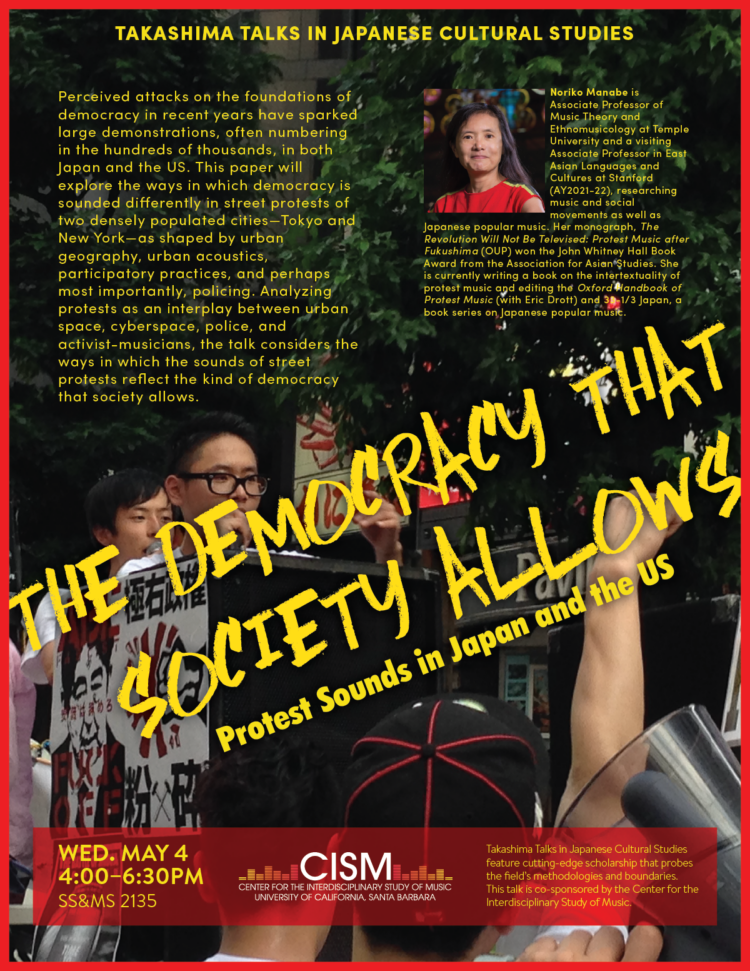
Banner for Takashima Talks in Japanese Cultural Studies: The Democracy that Society Allows, Protest Sounds Japan and the US

Takashima Talks: The Democracy That Society Allows — Protest Sounds in Japan and the US

Takashima Talks: The Democracy That Society Allows — Protest Sounds in Japan and the US

Perceived attacks on the foundations of democracy in recent years have sparked large demonstrations, often numbering in the hundreds of thousands, in both Japan and the US. This paper will explore the ways in which democracy is sounded differently in street protests of two densely populated cities-Tokyo and New York-as shaped by urban geography, urban acoustics, participatory practices, and perhaps most importantly, policing. Analyzing protests as an interplay between urban space, cyberspace, police, and activist-musicians, the talk considers the ways in which the sounds of street protests reflect the kind of democracy that society allows.

WEDNESDAY, MAY 4, 4:00 — 6:30 PM
UCSB Campus:  SS&MS 2135

Banner for Small Island, Big Song

Small Island BIG Song Performance at MCC Theater

Small Island Big Song explores the cultural connections between the descendants of the seafarers of the Pacific and Indian Oceans through the Austronesian migration. This concert will feature artists who have made a choice to maintain the cultural voice of their people, to sing in their language, and to play the instruments of their land.

Tuesday, April 26, 6 PM PST, UCSB MCC Theater

Book Cover for "A Study on the Influence of Ancient Chinese Cultural Classics Abroad in the Twentieth Century", translated by Bin Yao and edited by Xipang Zhang

Ursula Friedman’s New Co-Translated Book Published: “A Study on the Influence of Ancient Chinese Cultural Classics Abroad in the Twentieth Century”

Congratulations to Ph.D. student, Ursula Friedman for publishing her new co-translated book, A Study on the Influence of Ancient Chinese Cultural Classics Abroad in the Twentieth Century, Springer, Singapore 2022.

This book presents an extensive literary survey of the influence of ancient Chinese cultural classics around the globe, highlighting a mammoth research project involving over forty countries or regions and more than twenty languages. As the book reveals, ancient Chinese culture was introduced to East Asian countries or regions very early on; furthermore, after the late Ming Dynasty, Chinese “knowhow” and ideas increasingly made inroads into the West. In particular, the translation of and research on Chinese classics around the world have enabled Chinese culture to take root and blossom on an unprecedented scale.

In addition to offering a valuable resource for readers interested in culture, the social sciences, and philosophy, the book blazes new trails for the study of ancient Chinese culture.

Ursula Deser Friedman (Translator) is currently pursuing a Ph.D. in East Asian Languages and Cultural Studies, with an emphasis in Translation Studies, at the University of California, Santa Barbara. Ursula holds an M.A. in Foreign Linguistics and Applied Linguistics with specializations in Translation and Conference Interpretation from Beijing Foreign Studies University, where she has taught Mandarin-English Translation since 2017. Ursula’s publications have appeared in Translation ReviewInternational Communications and Modern Chinese Literature and Culture.