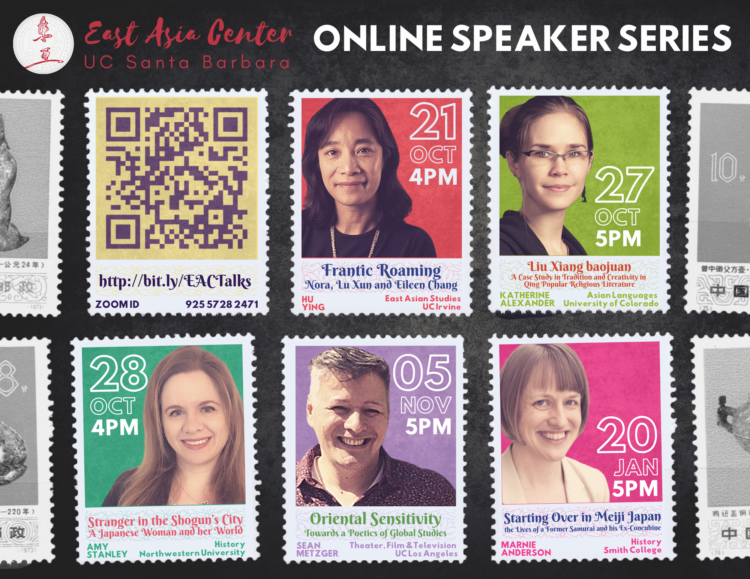
The East Asia Center has announced its Online Speaker Series from October 2020 through January 2021. Please join us for these virtual events!
The East Asia Center has announced its Online Speaker Series from October 2020 through January 2021. Please join us for these virtual events!
The Worst Chinese Poetry: A Virtual Workshop
April 5–9, 2021
Organized by Thomas Mazanec, Xiaorong Li, and Hangping Xu
Call for Papers
Good poems are all alike, but every bad poem is bad in its own way. Poems may fail according to aesthetic, formal, political, social, moral, and other criteria. There are failures of innovation and imitation, of quantity and quality, of ambition and cowardice. The purpose of this virtual workshop is to explore what was thought to be the very worst poetry written in Chinese and to understand why it was regarded so poorly. We want to know who considered it bad, and according to what criteria. By examining the “worst” poetry and the harshest judgments on it from antiquity to the present, we hope to offer a literary history as seen through failure.
The workshop will introduce and discuss primary texts that address the question of why a poem might be called “bad.” Participants are invited to submit up to 10 pages (inclusive of English translation) of “bad” Chinese poetry or critical writings on it from any historical period, accompanied by 5–10 pages (1250–2500 words) of critical introduction. Texts should highlight important moments in the history of bad poetry and how they relate to aesthetic, political, social, and conceptual norms. During the workshop, participants will meet on Zoom for several half-days to discuss the contributions.
Our definition of badness is broad. The awkward, the ugly, the wild, the immoral, the vulgar, the boring, the didactic, the unusual—all may be considered bad. Poetry that’s good in one context is often bad in another. Some topics that participants may wish to consider addressing include (but are not limited to):
Contributions will be collected, reviewed, and edited for publication as part of The Worst Chinese Poetry: A Critical Anthology. Abstracts of up to 250 words describing a Chinese text and its relevance to bad poetry are due by October 15, 2020. Full contributions will be due January 31, 2021. The workshop will convene the week of April 5–9, 2021.
Inquiries and proposals may be submitted to the organizers, Thomas Mazanec (mazanec@ucsb.edu), Xiaorong Li (lixiaor@ucsb.edu), and Hangping Xu (hangping@ucsb.edu).
Japanese Language Placement Test
The Japanese placement tests for Fall ’20 will be conducted in September on GauchoSpace and Zoom. Please go to our website below for more details.
http://japaneselanguage.eastasian.ucsb.edu/about/placement.htm
If you have any questions, please contact Yoko Yamauchi yokoy@eastasian.ucsb.edu
During the 2019-2020 academic year, our graduate students enjoyed great success winning awards, fellowships, and grants. We are truly proud of their academic achievements and offer them our warmest congratulations!
Carl Gabrielson, a Ph.D. candidate researching on contemporary Japan, was awarded a number of grants and fellowships: 1. UCSB Graduate Scholars Program Mentoring Grant; 2. UCSB Interdisciplinary Humanities Center Mellon Engaging Humanities Fellowship; 3. Japan Society for the Promotion of Science Short-Term Fellowship for Research in Japan (Project Title: “Orienting the Troops: Militarizing the Interpersonal in the U.S.-Japan Alliance”); and 4. Graduate Division Dissertation Fellowship.
Elizabeth Kataoka, a Ph.D. candidate specializing on modern Japan, was awarded a Fulbright Open Study Research Award and a 2020 Japan Foundation/UCSB Graduate Division Research Accelerator Award. She will continue researching for her dissertation project on “Assimilating Identity? Education, Epistemologies, and Ainu Consciousness in the Twentieth Century.”
Joseph Lovell, a Ph.D. candidate working on modern China, was awarded a highly competitive doctoral fellowship by the Chiang Ching-kuo Foundation. Joe’s dissertation project is titled “The Maoist Soundscape: The Usage and Reception of Amplified Sound in the People’s Republic of China, 1949-1976.”
Yiming Ma, a first year Ph.D. student, won a 2020 Japan Foundation/UCSB Graduate Division Research Accelerator Award, which will enable him to conduct preparatory archival research for his dissertation project on underground trans-war networks of Japanese and Chinese leftwing intellectuals and artists in Tokyo and Shanghai.
Keita Moore, a Ph.D. candidate working on contemporary Japan, received Japan Society for the Promotion of the Sciences (JSPS) Doctoral Fellowship for Research in Japan for his dissertation project titled “Grand Designs: Videogames, Societal Time, and Developer Agency in Contemporary Japan.” In addition, Keita also won the 2020 Koichi Takashima Graduate Research Award.
Kaitlyn Ugoretz, a Ph.D. candidate working on Shinto, received a number of important grants. She was awarded the Japan Foundation Doctoral Research Fellowship, a Social Sciences Research Council International Dissertation Research Fellowship (SSRC-IDRF), and a 2020 Japan Foundation/UCSB Graduate Division Research Accelerator Award for her dissertation project, “World-Wide Shinto: The Globalization of ‘Japanese’ Religion.” In addition, she received a GSA Excellence in Teaching award and is currently in the final stage of consideration for a Wenner-Gren Dissertation Fieldwork Grant.
Congratulations, all!
The 2019 Department newsletter is now available for download. Though delayed due to the pandemic, we are excited to tell you about many of the wonderful achievements of our students, alumni, faculty, staff, and programs.
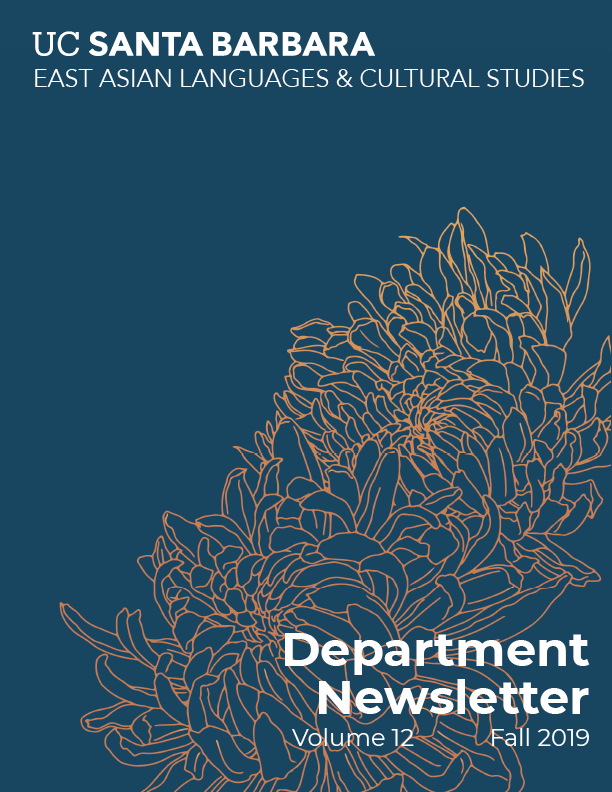
Table of contents:
The Center for Taiwan Studies (CTS) at the University of California, Santa Barbara, invites applications for a half-time Academic Coordinator I position. This is a 12-month fiscal year appointment (non-tenure track). The Academic Coordinator (AC) assists the Center for Taiwan Studies Director in developing and implementing programming consistent with the mission of the Center, including yearly international conferences of scholars whose work relates to Taiwan, and two to three quarterly events, such as movie showings, lectures, cultural events, graduate student forums, etc. The AC also assists, as needed, with events in the Department of East Asian Languages and Cultural Studies that include Taiwan in full or as a component. The goal of the programming at CTS is to promote Taiwan Studies and to educate students, scholars, and community members about the culture, literature, history, society, and politics of Taiwan. Candidates must be legally authorized to work in the United States without the need for employer sponsorship.
Program Administration
The AC performs administrative functions for CTS, serving as a key contact for all visiting speakers, UCSB faculty, staff and students, and the off-campus community. The AC oversees the coordination and implementation of all Center activities and interacts with public speakers and visiting scholars, writers, authors, and other public figures. This includes arranging accommodations, venues, food, technical assistance, logistics, agendas, name cards, posters, and office support.
The AC is also responsible for assisting the Director in implementing research and learning support opportunities for UCSB students and faculty associated with the Center. The AC manages routine communication with faculty and community members; supervises and coordinates visits and events, including receptions for visiting speakers; maintains budget records for the program; coordinates travel and lodging for speakers; supervises student assistants; maintains the website; and supervises public information materials, such as the quarterly calendar, publications, and interviews with speakers.
Program Analysis and Evaluation
The AC analyzes the Center’s budget and prepares regular reports for the Center Director regarding the Center’s finances. The AC assists with grant writing and reporting, and program analysis. The AC monitors the demographics of program attendance and works with other campus centers and programs to coordinate co-sponsored events and to ensure diversity of participants and audience. The AC assists the Director in writing and editing grant proposals and reports.
Publishing & Design Work
The AC edits and designs proceedings, anthologies of Taiwan literature, and other publication projects, including the biannual journal, Taiwan Literature: English Translation Series. Editorial assistance includes editing, writing, and proofreading for CTS publications, the CTS newsletter, webpages, and flyers for public lectures and cultural events
Basic Qualification:
•M.A. in the humanities or social sciences
Additional Qualifications:
•1-2 years of experience working within an academic institution
•1-2 years of experience in a position that required administrative and organizational activities
•1-2 years of experience designing marketing materials and books in InDesign and Photoshop
•2-3 years of experience using Word and Excel for standard administrative duties.
Preferred Qualifications:
•Experience coordinating public events
•Strong written, oral, and interpersonal communication skills
•Significant editing, writing, and proofreading skills and experience
•Ability to prioritize, conduct, and manage multiple projects
•Ability to oversee and mentor student assistants
•Experience in financial management
•Demonstrated ability to write reports and communications to high-level grant-dispensing institutions
•Familiarity with Taiwan and its culture
• Basic reading and conversation proficiency in Chinese language
Salary is based on UC salary scales and depends on qualifications. Complete applications received by July 24, 2020, will receive full review. To ensure full consideration, please submit the following electronically to https://recruit.ap.ucsb.edu/JPF01810:
• Cover letter
• Contact information for two references whom we may contact by email or phone.
• Current curriculum vita (CV).
The department is especially interested in candidates who can contribute to the diversity and excellence of the academic community. For information on our department, please visit our website: https://www.eastasian.ucsb.edu. Inquiries about the advertised position may be directed to our department’s Academic Coordinator, Natalie Juarez at nmjuarez@hfa.ucsb.edu. Please be sure to mention JPF01810.
The University of California is an Equal Opportunity/Affirmative Action Employer and all qualified applicants will receive consideration for employment without regard to race, color, religion, sex, sexual orientation, gender identity, national origin, disability status, protected veteran status, or any other characteristic protected by law.