Essay excerpt from "Of Admonition and Address: Right-Hand Inscriptions (Zuoyouming) from CuiYuan to Guanxiu" by Thomas J. Mazanec

New faculty publication on poetic address (Thomas Mazanec)

Professor Thomas Mazanec‘s article on the topic of poetic address in medieval China has been published in the 38th issue of Tang Studies. It will be of interest not only to specialists in Chinese literature, but to anyone interested in lyric theory or the poetics of inscriptions.

“Of Admonition and Address: Right-Hand Inscriptions (Zuoyouming) from Cui Yuan to Guanxiu.” Tang Studies 38 (2020): 28–56. PDF.

Abstract

This essay traces the development of the right-hand inscription (zuoyouming 座右銘) from its birth in the second century CE through its culmination as a complex literary subgenre in the tenth. Over the course of these eight centuries, right-hand inscriptions were used by some of the most prominent poets of their respective eras, including Cui Yuan 崔瑗 (77–142 CE), Bian Lan 卞蘭 (ca. 230), Zhi Dun 支遁 (314–366), Bai Juyi 白居易 (772–846), and Guanxiu 貫休 (832–913). These writers used the subgenre to advocate for many different kinds of wisdom, often reflecting intellectual trends of their times. The inscriptions underwent a process of literarization, meaning they became more deeply embedded in a self-consciously literary tradition. By the end of this process, with the poet-monk Guanxiu, the temporal spectrum of address (past-present-future) comes to dominate the others. Poetic address, in this subgenre of verse as in shi-poetry 詩, comes to focus more on the literary tradition itself than the poem’s immediate readership.

Professor Mazanec has also written about the story behind the article on his personal website. See here for more: http://tommazanec.com/blog/2021/01/20/article-on-poetic-address-published-in-tang-studies/.

 

Korea Foundation logo

Department Awarded Korea Foundation Grant To Help Establish Korean Studies Professorship

We are thrilled to announce that the Department has been awarded a five-year grant from the Korea Foundation to support the establishment of a tenure-track professorship in Korean Studies! This new position will help expand our growing offerings in Korean, including both language and content courses.

More details to follow in the coming year.

Jesus Loves Japan book cover by Suma Ikeuchi

Suma Ikeuchi Wins Francis L. K. Hsu Book Prize for Jesus Loves Japan

Our newest faculty member, Assistant Professor Suma Ikeuchi, has just been awarded the Francis L. K. Hsu Prize for the best book in the anthropology of East Asia by the American Anthropological Association’s Society of East Asian Anthropology. The prize is named for the late Francis L.K. Hsu (1909-2000), renowned cross-cultural anthropologist and former president (1977-78) of the American Anthropological Association. Book submissions from all four fields of anthropology as they relate to East Asia, as well as books that venture beyond standard ethnographic modes of writing are considered for this prestigious prize. Professor Ikeuchi is the first in the history of the Department and UC Santa Barbara to receive this prize.

Professor Ikeuchi’s book is titled Jesus Loves Japan: Return Migration and Global Pentecostalism in a Brazilian Diaspora (Stanford University Press, 2019). Here is the prize committee’s citation:

In this remarkable book, Suma Ikeuchi presents a captivating ethnography of Japanese Brazilians (Nikkei) at the intersection of Asian return migration and Latin American Pentecostalism. Situated in the factories, neighborhoods, and churches of Toyota City, Aichi Prefecture, Ikeuchi’s study explains how the political, economic, and psychological dimensions of mobility and belonging shape this transnational community and its increasing number of Pentecostal converts. Although Christians account for only about 1% of Japan’s population, the emphasis on religion in this book is crucial for understanding the specific community it seeks to depict and also significantly expands the analytical approach to studying Asian return migration beyond the more common ethnoracial categories of identity and belonging. The book is accessibly and elegantly written, but it does not shy away from complexity. Ikeuchi worked with and among a group that is truly “betwixt and between” in terms of the contradictions of race, nation, religion, and even social class in Japan. The multiple intellectual frameworks required to make sense of the ethnographic situation, and the author’s ability to pursue and explain it with great detail, intimacy, analytical precision, and coherence, are a testament to its anthropological contribution beyond Asian Studies.

Congratulations, Prof. Ikeuchi, on this magnificent achievement!


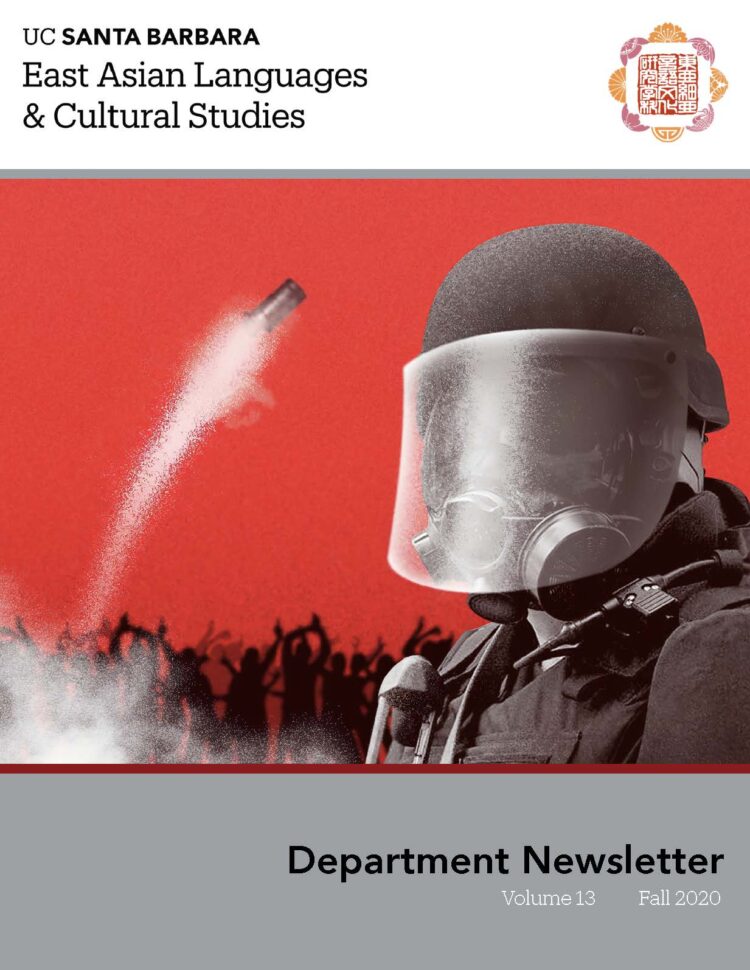
Cover of the fall 2020 newsletter. Features a person in riot gear standing in front of a vibrant red background, in which a canister of tear gas is vaulting into the air.

Fall 2020 Newsletter Released

Cover of the fall 2020 newsletter. Features a person in riot gear standing in front of a vibrant red background, in which a canister of tear gas is vaulting into the air.

We are pleased to announce the publication of our Fall 2020 Newsletter (vol. 13). In addition to reports from the programs and centers that are associated with the Department, we are proud to present two new faculty members, reflections on major academic and artistic events, our wonderful undergraduate and graduate students’ achievements, and our faculty members’ accomplishments along with numerous other contributions.