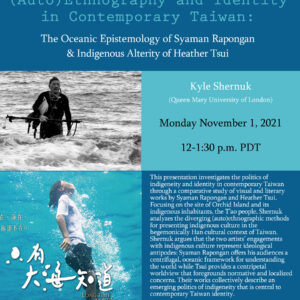
As part of the “Sound, Screen, and Stages from Taiwan” series at the Center for Taiwan Studies, we are pleased to welcome Prof. Kyle Shernuk (Queen Mary University of London) to speak on “(Auto)Ethnography and Identity in Contemporary Taiwan: The Oceanic Epistemology of Syaman Rapongan & Indigenous Alterity of Heather Tsui.”
The talk will take place on Monday, November 1, 2021, at 12:00–1:30pm PDT. Join us at: http://ucsb.zoom.us/j/82164088119. For more information, please consult the poster or email eastasian-taiwanstudies@ucsb.edu.
Every year, the Koichi Takashima Graduate Student Grant is given to one of the most promising graduate students in Japanese Cultural Studies. This year, Winni Ni impressed the selection committee with her pursuit of an exceptionally innovative and theoretically sophisticated dissertation titled, “Forms of Relating –The Representation of Intersubjectivity in Contemporary Border-crossing Literature (ekkyō bungaku) in Japan.” Border-crossing literature by contemporary authors who are non-native Japanese speakers, she writes, is commonly known for its polyphonic texts. Scholars have argued that authors create polyphonic texts to mirror and express the multi-lingual identities that resist being pinned down to any given category. This dissertation proposes to radically rethink border-crossing literature by focusing on the representation of relationships between the self and others within a community. Ni examines the narrative’s representations of ways of relating in various border-crossing contexts, exploring how the characters’ self-perceptions are co-constructed with other subjects in the present and in the past. She asks how border-crossing literature represents that process of co-construction using specific rhetorical forms and linguistic expressions, and how it creates a body of knowledge of intersubjective encounters across social, cultural, and linguistic boundaries.
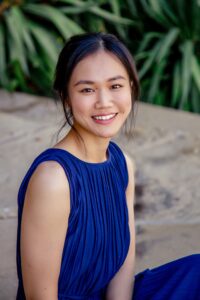
Winni Ni. Photo Credit to SJP Photography
Through close readings of the border-crossing fictions by Yang Yi (b. 1964), On Yūjū (b. 1980), and Sagisawa Megumu (1968–2004), Ni aims to elucidate the literary rendering of self-emergence through constant and dynamic exchanges with others. She argues that border-crossing literature provides an alternative cultural notion of happiness—one that is grounded in mutual recognition, psychological belonging, and trust. Border-crossing literature achieves this by representing moments of mutual recognition as transformative, enlivening, and deeply pleasurable: they are what the narratives and the characters return to again and again, through highly stylized plots and affectively engaging expressions. Combining literary analysis with psychological and social theories of self-formation, Ni intends to open up new perspectives on Japanese border-crossing literature and to encourage others to use these polyphonic narratives to imagine how individuals could live with their explicit differences—better and together.
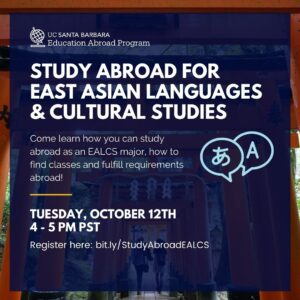
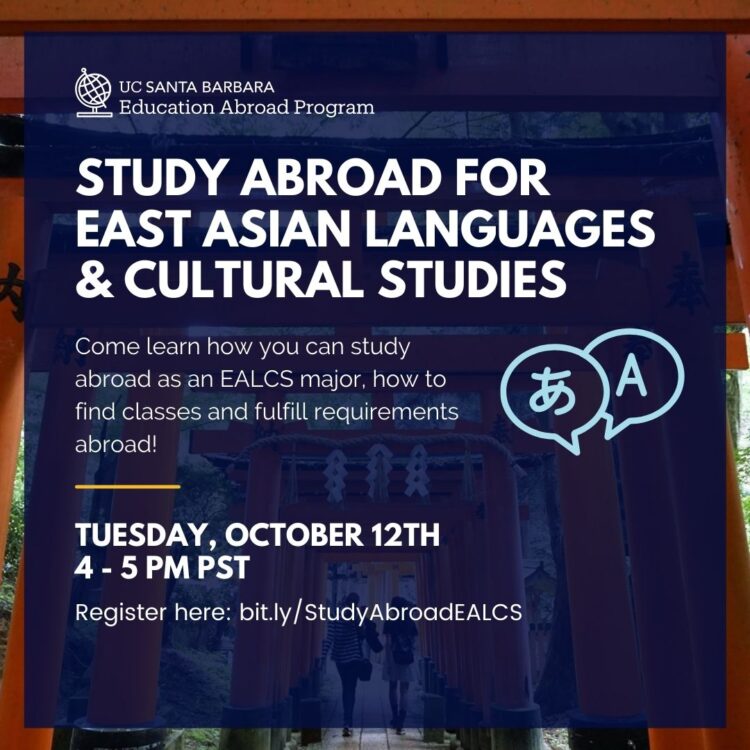
Next Tuesday, there will be an info session for study abroad opportunities for our majors through the Education Abroad Program The event will be on Zoom on Tuesday, October 12, 2021, 4:00–5:00pm.
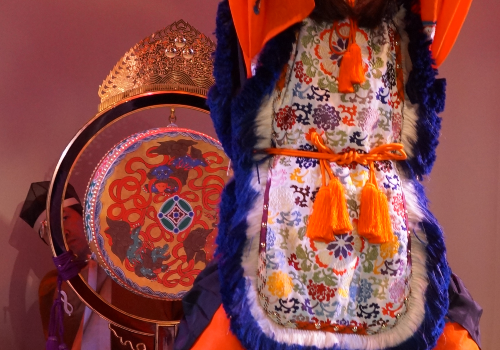
The Art, Design, & Architecture Museum at UCSB is displaying “Sound of a Thousand Years: Gagaku Instruments from Japan,” an exhibition organized by Fabio Rambelli, from September 25, 2021 to May 1, 2022.
Photograph by Daigengna Duoer.
It is an exhibition on Gagaku 雅楽, the ceremonial music and dance of the imperial court and the main Buddhist temples and Shinto shrines of Japan; as the oldest continuously performed orchestral music in the world (the tradition in Japan starts in the late seventh century), it has been designated by UNESCO as part of the world heritage.
Prof. Rambelli curated this exhibition with the help of Dr. Rory Lindsay (University of Toronto) and grad students from EALCS and Religious Studies—Kaitlyn Ugoretz, Mason Johnson, Mariangela Carpinteri, and Daigengna Duoer—based on a seminar of the cultural history of Gagaku held in Fall 2019. We are grateful to the Department of Ethnomusicology at UCLA for loaning several instruments, to Maestro Bunno Hideaki and the musicians and dancers of his Gagaku Ensemble (for allowing us to use photos and videos of their performances at UCSB in March 2020), and to the Music Department at UCSB for loaning some pieces from the Henry Eichheim Collection. Special thanks also to Professor Scott Marcus (Music Department).