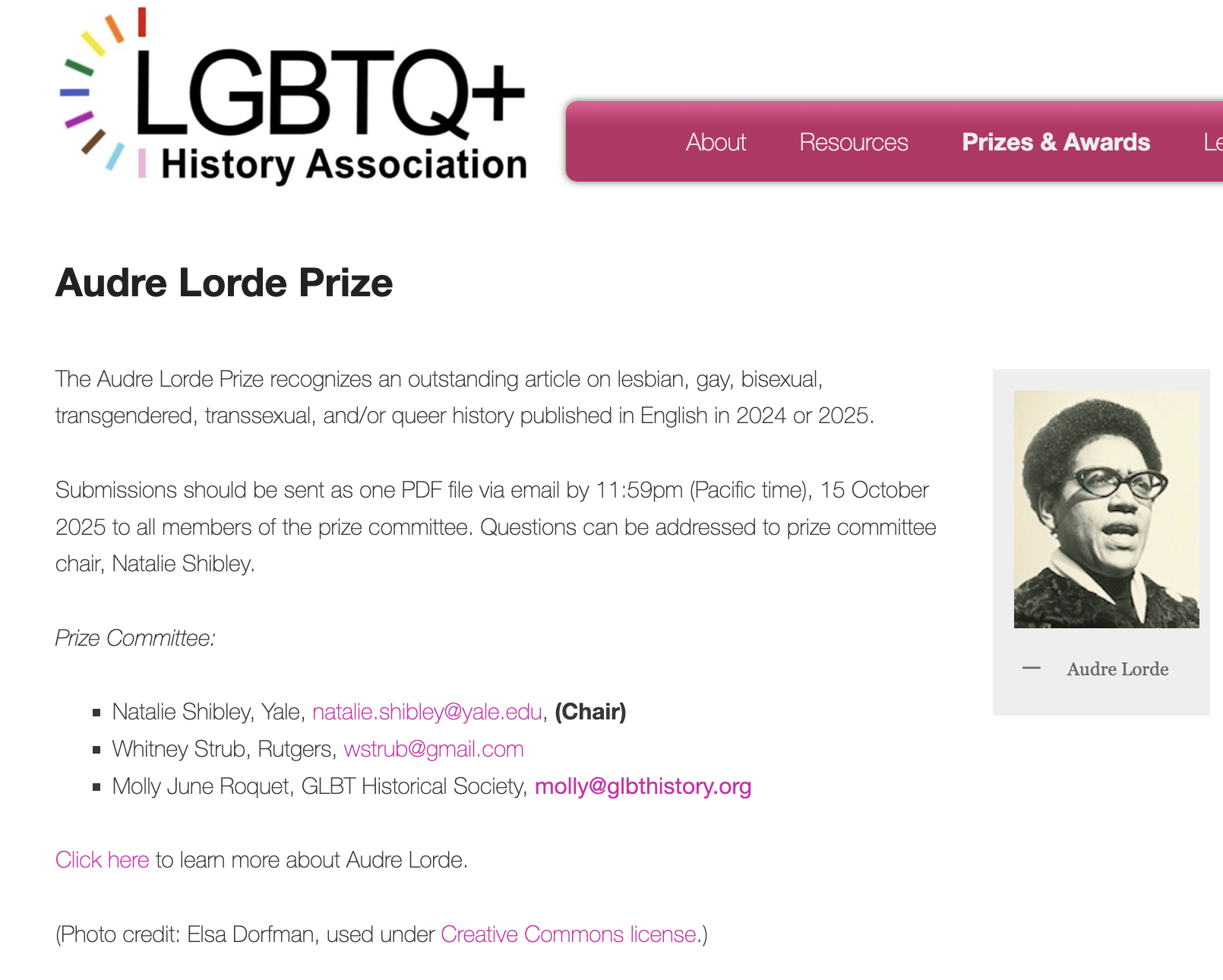
Prof. Howard Chiang recently won the 2026 Audre Lorde Prize for an Outstanding Article in LGBTQ History from the LGBTQ+ History Association, an affiliate of the American Historical Association, for his article, “Hide and Seek: Elmer Belt, Agnes, and the Battle over Castration in Transsexual Surgery, 1953–1962,” Bulletin of the History of Medicine 98, no. 3 (2024): 394–427.
The full citation, which can be found at https://lgbtq-ha.org/prizes/audre-lorde-prize, reads:
Howard Chiang’s deeply researched article makes an important contribution to trans history by shedding new light on the work of urologist Elmer Belt and the cryptorchidism surgical technique he practiced in the 1950s and early 1960s. Making revealing use of Belt’s correspondence, Chiang illustrates how developments in trans medicine were understood and negotiated between doctors and patients and between practitioners of different medical specialities in a particular moment of “transsexual science.” While Belt’s lack of publications later led to his being neglected by historians, Chiang convincingly uncovers “a largely forgotten surgical logic of trans embodiment” and carefully registers the agency of trans patients without obscuring the unequal power relations inherent to the medicalized setting.
Congratulations, Prof. Chiang!